Friday, November 8, 2019

Swiss Grand Circle - 01. Appenzell and St Gallen


Five hours after stepping off the plane at Zürich Airport, we’re arriving for lunch at Switzerland’s most iconic and historic restaurant, 1500m above sea level and accessible only via a soggy hike past grazing cows and through a sequence of prehistoric caves inhabited for centuries by hermit monks. If this weathered gasthaus standing precipitously underneath the towering cliff looks familiar to you, you’ve probably seen it on the cover of National Geographic’s Destinations of a Lifetime.


The Aescher Gasthaus is just one of the unique charms at this far-flung region of northeast Switzerland known as Appenzellerland, two sparsely populated cantons renowned for their distinctive festivals and ultra-traditional customs. This would be the start of our 16-day circle route to appreciate Switzerland’s cultural diversity, starting with possibly its most old-fashioned corner.


Outside Switzerland, Appenzell is best known as a quaint specimen of Swiss direct democracy for its annual Landsgemeinde, a 600-year-old tradition where citizens congregate at the town square to vote on cantonal governance issues by a public show of hands. And up until 1991 women had no right to vote in the Landsgemeinde, which shows just how culturally conservative this corner of Switzerland has been.


Among the Swiss themselves though, Appenzell is appreciated for its hard, spicy Appenzeller cheese featured on premium cheese platters across the nation, as well as the excellent Appenzeller Bier -- especially the unfiltered Quöllfrisch variety -- available at most supermarkets. Just 90 minutes from Zürich Airport via one of the world’s best train networks, we plunged right into the heartland of Swiss traditions on our first morning.


Our first interaction with the locals was at Appenzell Station where a gracious staff member agreed to safeguard our heavy backpacks for the day ... for free. Within minutes we unpacked our hiking poles and took the next train to nearby Wasserauen followed by a cable car up the local peak of Ebenalp, where a light 30 minute hike would lead us to Aescher Gasthaus for a late Sunday brunch.


Even before the establishment of Aescher Gasthaus in the late 1800s, mysterious Ebenalp had attracted centuries of pilgrims to its cave chapel and hermitage that provided food and lodging to the faithfuls. En route to the gasthaus, today’s hikers must still pass through a subterranean cavern once inhabited by Neanderthals and cave bears in the ice age, and by little hobbit-like people according to legends.


It was another busy Sunday in Aescher’s short operating season, lasting only from late May until mid-October, 130 plus years running. Until a couple years ago hikers could overnight at its detached mountain lodge next to the cave church before coming in for breakfast, though the nearest bathtub would be the local lake of Seealpsee in the valley below.


Just about every table washed down their obligatory charcuterie platter with shots of a local herb tonic known as Alpenbitter, or with the house’s full-strength apple cider. The smoked and thinly sliced Mostbröckli and sharp Appenzeller cheese were appealing, but the real star -- and both my wife and I agreed -- was a simple Schwartenmagen head cheese that might have been our favourite charcuterie item of the entire trip.


We fuelled up further with a house made cheese pie that came with a sauce I had never dreamed of, an earthy pesto of wild nettle -- yes, the same stinging nettle for treating allergy symptoms -- that perfectly toned down the oiliness of the melted cheese and elevated the homey fare into gastronomic sophistication. One has to be impressed with the chef’s resourcefulness demonstrated by the originality of menu items, considering that fresh supplies only get towed in twice weekly by farm tractors.

Meal for Two Persons
Cold PlatterCHF 26
Cheese Pie with Nettle SauceCHF 12
Bottle of Flauder 0.5 LCHF 5.5
Apple Cider 0.5 LCHF 6.5
TOTALCHF50 (CAD$69)


Back in Appenzell after our lunch and hike, we finally reached the town’s historic quarters among a surprising number of multi-national tourists arriving on tour buses for the Sunday afternoon. Fortunately few would remain after sundown, as we would soon learn over two nights in town.


Noiseless and vacant as Landsgemeindeplatz appeared on this day, this is the venue for the annual cantonal assembly in April when any citizen can rise to the podium to propose changes for the other 4,000 to approve or vote down by a show of hands. While the women bring their voter cards, most men still carry their personal ceremonial sword which also qualifies as voter ID from a tradition dating back to the 1400s.


For those of us arriving outside of Appenzell’s various colourful festivals, its living traditions are always on display at Museum Appenzell inside a historic house next to the town hall. The historic quarter is full of fascinating vintage houses, one of which we would be renting for two nights.


Or at least the bottom floor of a traditional 4-storey Appenzeller house belonging to a winery proprietor, a 2 minute walk east of town centre and 7 minutes from the train station. Next door happened to be the local institution of Bäckerei Böhli, a 5th generation bakery apparently popular with the townsfolk judging by line-ups forming as early as 06:30.


To be completely honest, we chose this house as it was the cheapest accommodation available in the old town and within walking distance from the train station, at a one-third discount compared with the cheapest hotel. And in practical terms, a functional kitchen is simply indispensable for budget travelers in expensive Switzerland.


For two nights we cooked our own meals and sampled two regional favorites, the Appenzeller Siedwurst and the St Galler Kalbsbratwurst picked up from local supermarkets. The Appenzeller version pictured, with its silky texture and mild peppery spices, turned out to be my favourite out of all regional specialty sausages that we sampled across Switzerland.


As for picnics and hikes, we followed the local wisdom and purchased from Bäckerei Böhli these traditional form of energy bars: a gingerbread with almond filling known as the Appenzeller Biber (pictured left), and a bar of dried pears known as Birnweggen (right). Combined with a chicken leg from Migros and some packaged salad, these made for a cheap and filling lunch on the go.


As one of Switzerland’s greenest cantons where dairy farming remains a common career, Appenzell’s greatest appeal arguably lies in its picturesque countryside and small towns, conveniently connected by the private Appenzeller Bahnen with its half-hourly train service. Our original plan was to hike the Hundwiler Höhi from Gonten back to Appenzell, but we switched to visiting Urnäsch on a rainy day.


A small town even by the standard of Switzerland’s least populous cantons, charming Urnäsch looms large on tourism brochures with its 17th century town square and an outstanding museum, in fact my favourite in Switzerland over our 16-day journey.


Housed inside a 400-year-old half-timber building with low vaulted ceilings and crooked wooden floors, the Appenzeller Brauchtumsmuseum hosts the most comprehensive collection relating to Appenzell’s rural customs from the bi-annual livestock processions to hands-on practices with traditional musical instruments.


Most memorable were vivid exhibits of the canton’s Silvesterchläuse festivities on New Year’s Eve, a millennium-old pagan tradition in which a team of masked villages would dress in flamboyant costumes, wear 30 kg cow bells and yodel from house to house wishing everyone a prosperous new year.


Just 30 minute north of tiny Urnäsch, crossing cantonal boundaries and into a 21st century urban spread, is eastern Switzerland’s commerce and transportation hub of St. Gallen. Visitors arrive at a train station surrounded by a glass-and-concrete business district and filled with legions of daily commuters to Zürich, yet just a 10 minute walk from a medieval town centre crowned with a UNESCO World Heritage Site.


Predating the birth of the Swiss nation by 500 years, the medieval Abbey of St. Gall began as a humble Benedictine monastery and blossomed into a powerful theocratic city-state reporting only to the Holy Roman Emperor. Today it is revered among Switzerland’s most important cultural heritage as evidenced by the masses of high school students on field trips.


Striking as the cathedral’s baroque ceiling may appear, it pales in comparison to the abbey’s magnificent library possessing one of the world’s greatest collections of medieval codices dating to the 8th century. If you’re interested in viewing the select thousand-year-old manuscripts on display, visit in person as no pictures are allowed.


Back in Appenzell we spent the rest of the drizzly afternoon in shops and supermarkets. In better weather I would have loved to hike the Hundwiler Höhi for its panoramic views, but we salvaged what we could by shuffling Gasthaus Aescher to our only dry half-day. This would not be the last time that we had to reschedule our hikes and excursions according to Meteo Swiss’s incredibly accurate forecasts.

Friday, October 25, 2019

Swiss Grand Circle - 10 Tips for Budget Travelers


When we decided to travel to Switzerland this year, one of the first things I did was googling up its Big Mac Index.

You know, the tongue-in-cheek measurement of purchasing power developed by The Economist by comparing the prices of Big Macs around the world. As of 2019, a Big Mac meal with large fries and large drink in Switzerland cost CHF 13 (CAD$17.9), 89% more expensive compared with CAD$9.5 in my home country. And I thought Canada was expensive enough for the average traveler.

For readers planning a trip to Switzerland, here are ten proven strategies that helped us keep our budget under control in the most expensive nation we have visited to date.

1. Get MeteoSwiss on your phone. Mountain gondolas are notoriously expensive, and I cannot emphasize how tremendously useful -- and incredibly accurate! -- Swiss weather forecast is for travelers to this mountainous nation. Rainy Tuesday afternoon? Shift your gondola ride to Wednesday morning! With the app displaying precipitation over the next 6 days -- and in 15 minute intervals for the upcoming half-day! -- this is miles ahead of anything I’m used to in North America.


2. Get the SBB app on your phone. After fine-tuning your itinerary according to the weather, the SBB app will be essential for finding your next train, bus, ferry or gondola connection.


3. Install a peak-finding app on your phone. Skip the tour guides -- this GPS-based app will tell you the names and elevation of the gadzillion impressive peaks in front of your phone camera. Remember to pre-download the map data before your trip so that you’re not wasting roaming data.

4. Get a Half Fare Card or Swiss Travel Pass if you’re here for a week or more. Nobody pays full price on those expensive Swiss trains -- you either purchase a Half Fare Card like the locals, or you get a Swiss Travel Pass for your stay. Unfortunately for budget travelers, determining which one to get is a massively time-intensive analysis of tallying up all your train tickets, museum visits and even some mountain gondola rides for the entire trip. So I have developed some quick guidelines listed below:

5. Swiss Travel Pass may be better than the Half Fare Card for you if:

- Your trip in Switzerland lasts for roughly the duration of the Pass: 4, 8 or 15 days at the time of writing. We used a 15-day pass for our 16-day itinerary, paying full fare only on the final train ride to the airport.

- You plan on doing a lot of museums and pleasure boat rides: Ballenberg Open-Air Museum, the castles at Chillon, Gruyères and Bellinzona, UNESCO St. Gallen Abbey, passenger cruises on Lake Geneva and Lake Brienz to name a few. With the Swiss Travel Pass these are all completely free, which turned into CHF 100+ per person savings in our itinerary.

- You plan on visiting at least one of the Swiss Travel Pass’s freebies mountains. Every year the pass offers free access to a few popular mountains which, at the time of writing, included the spectacular Schilthorn for a CHF 41 saving even at Half Fare.

- You may change your plans according to weather. This was my number one reason for picking the Swiss Travel Pass over the Half Fare Card, so that I needed not worry about the cost of extra train trips when I changed my plans (as I often did) at the last minute.

6. Half Fare Card may be better than the Swiss Travel Pass for you if:

- Most of the above advantages of the Swiss Travel Pass don’t apply to you, plus ...

- If you’re spending a lot of time in the Jungfrau region. One sneaky trick of the Swiss Travel Pass is that it offers only a 25% discount on the Jungfraubahn, whereas the Half Fare Card offers the usual 50%. If you’re planning to spend several days hiking above Wengen and Grindelwald (which serve as boundaries of free access for the Swiss Travel Pass), you’ll want to look into the Half Fare Card.

7. When in St Moritz, stay only with a hotel that offers free Mountain Railway access (Bergbahnen Inklusive). The Engadin Valley remains one of the only places in Switzerland that offers no discount for mountain gondolas even if you hold a Swiss Travel Pass or Half Fare Card. But if you stay two or more nights at participating hotels along the valley (which includes Samedan, Pontresina and other cheaper towns outside of St Moritz), those expensive gondola and funicular rides suddenly become free! In our case, we went up and down Diavolezza (CHF 72 per couple), Alp Languard-Muottas Muragl (CHF 70 per couple) and Corviglia (CHF 100 per couple), a combined saving of CHF 242 for booking into a 4-star hotel in Samedan that cost just CHF 311 total for two nights, including taxes.


8. Prep your own meals. Denner and Aldi -- two of Switzerland’s largest discount supermarket chains -- are your friends in addition to the omnipresent Migros and Coop. At the time of writing a typical bratwurst entrée at a typical Swiss restaurant cost around CHF 23. In the same week, bratwursts were on sale at Migros for CHF 5 for five sausages! Whether you’re staying in an apartment or in a hostel, make good use of your kitchen.

9. Pick up local specialties from the family-run butchers and bakeries ahead of your hikes. Fancy those mouth-watering charcuterie platters at the mountain gasthaus in the middle of your hike? You could easily visit your local metzgerei and bäckerei and pick up some mostbröckli and speck, and perhaps some birnbrot, local cheeses and wine for a sumptuous mountain top picnic at a fraction of the price! You could pick up similar items at Migros or Coop, but I always find the small, family-run metzgerei to offer higher quality and often exotic items like deer jerky and wild boar sausages. And remember, cervelat sausages and landjäger jerky can be served without cooking.

10. ALWAYS fill up your bottle at the water fountains. It’s no secret that most Swiss restaurants charge you for tap water -- the same water that comes out of your hotel faucet or a public water fountain. We made the mistake of not filling our bottle prior to one hike, and the little restaurant at the hilltop happily charged these two dying hikers CHF 9 (CAD$12.4) for a 1.5 L bottle of sparkling water. Lesson well learned.

Saturday, October 19, 2019

Swiss Grand Circle on a Budget

This is the unfinished index page of our 16-day self-guided trip of Switzerland starting and ending at Zürich Airport. Articles will be slowly added over the coming months, so stay tuned.

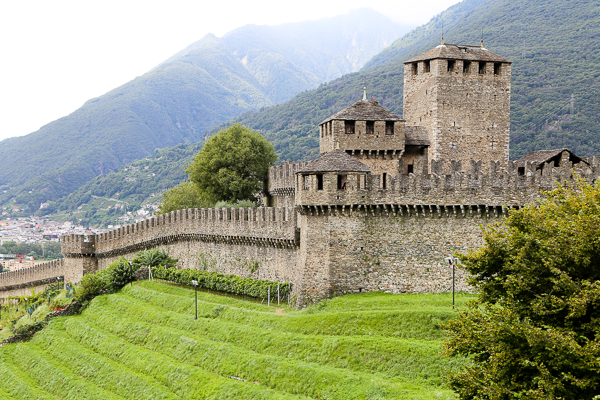
Holding our 15-day Swiss Travel Passes, we visited Appenzell and Ebenalp, St Gallen, St Moritz and its nearby mountains, Bellinzona and its castles, Locarno, Domodossola (Italy), Zermatt, Chateau de Chillon, the Lavaux vineyards, Montreux, Gruyères, Murten, Bern, Jungfrau and Schilthorn in the Bernese Highlands, Lauterbrunnen, Brienz, and finally Luzern.


Swiss Grand Circle - 08. Cheesy Visit to Gruyeres
Click HERE to Enter


Swiss Grand Circle - 07. Hiking the Lavaux Vineyards
Click HERE to Enter


Swiss Grand Circle - 06. Zermatt and the Matterhorn
Click HERE to Enter


Swiss Grand Circle - 05. Domodossola, Italy?
Click HERE to Enter


Swiss Grand Circle - 04. Bellinzona and Locarno
Click HERE to Enter


Swiss Grand Circle - 03. St. Moritz's Spectacular Panorama Trail
Click HERE to Enter


Swiss Grand Circle - 02. St. Moritz on the Cheap
Click HERE to Enter


Swiss Grand Circle - 01. Appenzell and St Gallen
Click HERE to Enter


Swiss Grand Circle - 10 Tips for Budget Travelers
Click HERE to Enter


Swiss Grand Circle on a Budget - Itinerary
Click HERE to Enter

Swiss Grand Circle on a Budget - Itinerary


Our 16-day Swiss Grand Circle itinerary was born out of the following philosophies:

1) Keep a low budget. Ditch the car and hop on Switzerland’s peerless train network. Cook our own meals in apartments where possible instead of staying in hotels and dining out. You get the picture.

2) A broad sampling of Switzerland’s diverse regions. From ultra-traditional Appenzell to the glitzy resort of St Moritz. From the German-speaking highlands to the Italianate canton of Ticino to the French-speaking towns of Lake Geneva. Even passing through small town Italy for a night, all covered by the Swiss Travel Pass.

3) Iconic sights. Matterhorn looming over Zermatt at sunrise. Jungfrau and its eternally glaciated summit. The cliff-side mountain tavern at Ebenalp. Afternoon tea at Badrutt’s Palace in St Moritz. Bern and its medieval townscape. Turquoise mountain lakes. A cheese factory. 13th century castles. Vineyard hikes. And hitting eight UNESCO World Heritage Sites en route.

The Swiss Travel Pass came in 4-day, 8-day or 15-day versions at the time of writing. For our 16-day itinerary we had the choice of paying full price on either Day 1 or Day 16. Our final itinerary was as follows:

Day 01: (Start of 15-Day Swiss Travel Pass) Zürich Airport - Ebenalp Aescher Hike - Appenzell
Day 02: Appenzell - Urnäsch - St Gallen - Appenzell
Day 03: Appenzell - St Moritz - Muottas Muragl Panorama Hike - St Moritz
Day 04: St Moritz - Diavolezza Hike - Corviglia Hike - St Moritz
Day 05: St Moritz - Bellinzona - Castle Hike - Locarno
Day 06: Locarno - Domodossola - Sacro Monte Calvario - Domodossola
Day 07: Domodossola - Saturday Market - Zermatt - Gornergrat Rail - Zermatt
Day 08: Zermatt - Klein Matterhorn Cableway - Zermatt
Day 09: Zermatt - Chillon Castle - Lake Geneva Cruise - Lavaux Vineyard Hike - Montreux
Day 10: Montreux - Gruyères - Montreux
Day 11: Montreux - Murten - Bern
Day 12: Bern - Schilthorn Cableway - Trümmelbach Falls - Lauterbrunnen
Day 13: Lauterbrunnen - Männlichen-Kleine Scheidegg Hike - Jungfrau - Lauterbrunnen
Day 14: Lauterbrunnen - Lake Brienz Cruise - Ballenberg - Lauterbrunnen
Day 15: Lauterbrunnen - Luzern (End of 15-Day Swiss Travel Pass)
Day 16: Luzern - Zürich Airport (Pay full price)

Note that I purposely skipped Basel after visiting the city several years back, but that can be inserted into the itinerary by adding one more day before Bern. Also, fans of Geneva or Lausanne could replace Montreux with their favourite city on Lake Geneva as a homebase, albeit with longer travel times to Gruyères and possibly warranting at least one more day.

Friday, June 7, 2019

Balkan Road Trip - 21. Shirakawa-go of the Slovenian Alps


The spectacular herdsmen village of Velika Planina was a fitting climax and final stop of our 22-day Balkan Road Trip, which kicked off on a sun-drenched Greek island in the Adriatic and wrapped up at a cosy chalet a mile high in the Slovenian Alps.


Exactly 10 years ago, we visited Shirakawa-go in mountainous Central Japan and became mesmerized by the ingenuity of its Gassho-zukuri cottages, engineered to withstand the heaviest snowfalls of the Japanese Alps with nothing but local cedar and thatch. And the same bewilderment overcame me when I first saw a picture of this eeriely similar hamlet, halfway around the world in Slovenia, known as Velika Planina.

Velika what?


I dare to say that 99% of visitors to Slovenia -- not exactly a tourism heavyweight compared with neighbouring Croatia or Italy -- have never heard of Velika Planina, not surprising as the remote settlement lacks the prestige of UNESCO World Heritage Site designation and international fame that Shirakawa-go enjoys. Despite its near anonymity, its photogenic quality as an alpine village is arguably unmatched in the entire Slovenian Alps.


Inaccessible to outsiders until the 1950s, the high altitude pastures of Velika Planina have been seasonally inhabited by Slovenia's indigenous cowboys who nourish their livestock here every summer before retreating to the valleys for winter. Centuries of geographical isolation has led to a fascinating local culture with its own unique architecture, traditional costumes and gastronomic inventions.


Even in the 21st century, access to the 1500+ metre plateau is provided largely by a relay of cable car and seasonal chair lift installed for alpine skiers. Frequent buses connect Ljubljana to the picturesque local town of Kamnik, making Velika Planina a possible day-trip from the Slovenian capital. With two full days we took a direct bus from Ljubljana to the cable car station, overnighted in a mountain top chalet, visited Kamnik on the way back before returning to Ljubljana for our flight home.


The weather could hardly be worse. In drenching rain the cable car took us up two-thirds of the way, connecting with a two seater ski lift that was stopped due to lack of demand and restarted just for the two of us. It was my wife's first ever ride on a topless chair lift, through a rainstorm as we huddled underneath a flimsy retractable umbrella.


Having arrived at the top in our soaking wet parkas, we decided to take refuge at the nearest mountain chalet to warm up with a hot meal while waiting for our cottage's caretaker to show up. What was supposed to be a quick pit stop at Zeleni rob (see map) turned into our most memorable lunch in Slovenia.


Chuckling at the far corner was a wrinkled herdsman, at least in his 50s and dressed in a traditional cape of shaved tree bark, pointy wooden clogs and round black hat, and carrying a long staff. So we had Gandalf from Lord of the Rings chatting up the young waitresses at one corner, a family of Slovenian hikers at another and a modest spread of hearty alpine grub arriving at our table. The ambiance was dreamlike.


The local staples of barley stew and Kranska klobase provided sufficient fuel for our afternoon hike, but it was an exceptional soup of seasonal wild mushrooms that elevated this humble meal to an unexpected gastronomic delight at an alpine hut. After all this wasn't quite St. Moritz in Switzerland, and we're paying only 6 euros for the soup.


While we were finishing our slab of Gibanice, a quiet man sitting next to Gandalf suddenly spoke up in broken English and asked whether we were from Canada. It was then that we realized ... this was the mysterious caretaker that we had been waiting for!


Unbeknown to us as we were lunching and drying our clothes at Zeleni rob, our attentive caretaker had been busy kindling fires for our furnace and our outdoor hot tub in anticipation for our arrival. A couple dozen such cottages scatter on the northwestern side of Velika Planina, modelled after the herdsmen huts and fitted with modern amenities catering to us lowlanders.


No more than 35m2 in size, our cottage likely slept up to six adults between a bunk bed on the main floor and a small attic accessible only by hatch door and ladder. The 21st century necessity of Wifi turned out invaluable for contacting the management in emergencies, as we would learn that evening.


Main floor featured an old-fashioned kitchen with a Yugoslav-era wood burning stove that doubled as the heating furnace for the small cottage. Bottled water and a limited supply of imperishable food were available for purchase in the storage room, though it would be wise to carry in your own food and drinks in your backpack.


Towards the back door was a mud room for hiking boots or perhaps skiing equipment, a shower equipped with an electric water heater and best of all, an infrared sauna for the frosty evenings. This was far from the hard lives of the roving herdsmen, but it was also tantalizingly decadent.


The most intriguing feature was an outdoor hot tub fueled by fire wood. The design was brilliantly simple with a regular hot tub fitted with a semi-submerged metal box that heated the water with the wood burning inside. Along with the infrared sauna, this was our evening entertainment on the remote mountain top.


Fifty years after Slovenian architects started adapting the herdsmens' folk architecture into modernized cottages, the tourist quarter has grown into a side business that supplemented the community's income while introducing a disappearing facet of Slovenian culture to the masses. Meanwhile the original Batje huts have since been elevated to national cultural heritage status.


A 15 minute hike to the east began the expansive landscape of alpine meadows that coined the term Velika Planina, or Big Pasture, speckled with herdsmen huts sporting the signaturelow roofs covered with weathered spruce shingles and few exterior windows. Aside from the occasional solar panels and ATVs parked in front, it could have been a picture from the 16th century.


Every year the herdsmen would arrive en masse in June, performing annual maintenance on their seasonal town and making communal plans at a makeshift assembly house nicknamed the parliament, all governed by a council with its own president. Towards the end of the grazing season the community would disperse back to their individual farms ahead of the first snow in the Kamnik Alps, which could arrive as early as October.


Revealed before our eyes was a semi-nomadic commune of herdsmen huts with uncanny resemblances to Japan's Shirakawa-go, both being remote alpine villages surviving from the Middle Ages. While its Japanese cousin has developed a 60-degree thatch roof capable of bearing five metres of annual snowfall, Velika Planina has developed a drooping roof extending almost to the ground to survive the 100 km/h gusts and blinding snow drifts of the Slovenian Alps with minimal maintenance, as the cottages are meant to be buried under a heavy layer of snow until late spring.


The term convergent evolution comes to mind from university biology lectures, describing how unrelated organisms develop analogous traits as a result of adaptation. The same can be seen in architecture where human ingenuity across continents independently arrive at similar solutions when faced with similar climatic hardships, as in this example of two alpine settlements.


At the village's high point stands a cottage-shaped chapel known as Our Lady of the Snows, burned down by Nazi troops in WWII and rebuilt in 1988 based on the original plans by the legendary Joze Plecnik, arguably Slovenia's greatest architect. Its Midnight Mass still draws hundreds of faithfuls to congregate in the freezing cold every Christmas Eve.


Velika Planina would have been a prime candidate as a UNESCO World Heritage Site, except all of the historic huts had been razed to the ground during WWII with only one -- the minimalist Preskar's Hut preserved as a museum since -- rebuilt entirely according to its pre-war appearance. Nowadays a number cottages still retain the village's unique semi-oval floor plan, though many had been rebuilt in a newer rectangular form.


With Zeleni rob closing at 18:00, we headed back and made a simple dinner -- our first time on a wood-burning stove -- out of a supermarket risotto mix, canned goulash, and a mushroom soup with fresh wild mushrooms purchased at Ljubljana's open air market that morning. The idea was to finish dinner and spend most of the night in the hot tub and sauna room, until ...


... the power went out while I was taking a shower!

After rinsing off the shampoo in pitch dark with icy cold water, I called the management and hoped that someone could get to our remote cottage before the morning. Incredibly a two-person crew showed up at our doorstep within 10 minutes and reset our well-hidden circuit breaker. We learned not to take a hot shower while turning on the infrared sauna, which was quite enjoyable once we figured out how things worked.


We went to bed hoping for better weather the next morning, but it turned even foggier as we took one last stroll amongst the herdsmen settlement prior to checking out. So we never encountered the elusive cheese makers and their legendary Trnic cheese, molded in the shape of female breasts and customarily gifted to the herdsmen's wives and prospective girlfriends. Just one of the colourful rituals that this isolated alpine village is known for.

BONUS SIDE-TRIP TO KAMNIK


A trip to Velika Planina automatically comes with the chance to visit one of Slovenia's prettiest medieval towns, as all buses from Ljubljana inevitably passes through historic Kamnik. Buses were rare on Sundays as we found out, and our one-way taxi from Velika Planina cost 15 euros.


Once the capital of Carniola, sleepy Kamnik is now best known for its pair of evocative castles inherited from its former Bavarian and Austro-Hungarian overlords. While the larger Grad Zaprice hosts the town museum within an 18th century Baroque palace, it is the pictured Mali Grad and its cute double chapel that has become the town's symbol.


From the top of Mali Grad one can appreciate the medieval layout at one of Slovenia's oldest towns, featuring charming squares, 16th century guild halls and a Franciscan monastery famous for a newer chapel also designed by Joze Plecnik.


With nearly every shop and restaurant closed on Sunday, we fueled up with leftover bread from breakfast before sitting down at Kavarna Veronika (see map) for coffee and dessert. On a weekday we would have visited the town museum at Grad Zaprice and perhaps one of the new microbreweries that Kamnik has become famous for in recent years.


After the light meal we caught the next bus back to Ljubljana and spent our final afternoon at the few supermarkets open on Sunday, completing our last minute souvenir shopping prior to our evening flight. After traveling 1200 km through six countries in the Balkans, it was time to go home and pay for the bill.


In hindsight we could have held off booking our cottage at Velika Planina until the last minute in hope of picking a sunnier date, but we should be satisfied with memories of that magical hour as we strolled through this inimitable medieval village. Velika Planina is not quite Shirakawa-go yet -- as of 2019 it remains largely unknown to foreigners and, perhaps most amazingly, villagers outnumbered tourists on the day of our visit. Get here soon, before it gets discovered by 21st century mass tourism.

IF YOU GO

Velika Planina is easily accessed by a cable car nearly year round, but the best season for hikes is between June and September. The bottom station is 90 minutes from Ljubljana on direct buses operating in high season. Alternatively one could take one of the frequent buses to Kamnik's bus terminal and transfer to a local bus for Kamniska Bistrica. If scheduled buses don't work for you, our taxi from the cable car station back to Kamnik cost about 15 euros as of 2018. One more practical tip -- the Tourist Info office at Kamnik's town square was happy to stash my backpack for a few hours while we toured the historic town. Don't bank on leaving it overnight though.