The spectacular herdsmen village of Velika Planina was a fitting climax and final stop of our 22-day Balkan Road Trip, which kicked off on a sun-drenched Greek island in the Adriatic and wrapped up at a cosy chalet a mile high in the Slovenian Alps.

Exactly 10 years ago, we visited Shirakawa-go in mountainous Central Japan and became mesmerized by the ingenuity of its Gassho-zukuri cottages, engineered to withstand the heaviest snowfalls of the Japanese Alps with nothing but local cedar and thatch. And the same bewilderment overcame me when I first saw a picture of this eeriely similar hamlet, halfway around the world in Slovenia, known as Velika Planina.
Velika what?

I dare to say that 99% of visitors to Slovenia -- not exactly a tourism heavyweight compared with neighbouring Croatia or Italy -- have never heard of Velika Planina, not surprising as the remote settlement lacks the prestige of UNESCO World Heritage Site designation and international fame that Shirakawa-go enjoys. Despite its near anonymity, its photogenic quality as an alpine village is arguably unmatched in the entire Slovenian Alps.

Inaccessible to outsiders until the 1950s, the high altitude pastures of Velika Planina have been seasonally inhabited by Slovenia's indigenous cowboys who nourish their livestock here every summer before retreating to the valleys for winter. Centuries of geographical isolation has led to a fascinating local culture with its own unique architecture, traditional costumes and gastronomic inventions.

Even in the 21st century, access to the 1500+ metre plateau is provided largely by a relay of cable car and seasonal chair lift installed for alpine skiers. Frequent buses connect Ljubljana to the picturesque local town of Kamnik, making Velika Planina a possible day-trip from the Slovenian capital. With two full days we took a direct bus from Ljubljana to the cable car station, overnighted in a mountain top chalet, visited Kamnik on the way back before returning to Ljubljana for our flight home.

The weather could hardly be worse. In drenching rain the cable car took us up two-thirds of the way, connecting with a two seater ski lift that was stopped due to lack of demand and restarted just for the two of us. It was my wife's first ever ride on a topless chair lift, through a rainstorm as we huddled underneath a flimsy retractable umbrella.

Having arrived at the top in our soaking wet parkas, we decided to take refuge at the nearest mountain chalet to warm up with a hot meal while waiting for our cottage's caretaker to show up. What was supposed to be a quick pit stop at Zeleni rob (see map) turned into our most memorable lunch in Slovenia.

Chuckling at the far corner was a wrinkled herdsman, at least in his 50s and dressed in a traditional cape of shaved tree bark, pointy wooden clogs and round black hat, and carrying a long staff. So we had Gandalf from Lord of the Rings chatting up the young waitresses at one corner, a family of Slovenian hikers at another and a modest spread of hearty alpine grub arriving at our table. The ambiance was dreamlike.

The local staples of barley stew and Kranska klobase provided sufficient fuel for our afternoon hike, but it was an exceptional soup of seasonal wild mushrooms that elevated this humble meal to an unexpected gastronomic delight at an alpine hut. After all this wasn't quite St. Moritz in Switzerland, and we're paying only 6 euros for the soup.

While we were finishing our slab of Gibanice, a quiet man sitting next to Gandalf suddenly spoke up in broken English and asked whether we were from Canada. It was then that we realized ... this was the mysterious caretaker that we had been waiting for!

Unbeknown to us as we were lunching and drying our clothes at Zeleni rob, our attentive caretaker had been busy kindling fires for our furnace and our outdoor hot tub in anticipation for our arrival. A couple dozen such cottages scatter on the northwestern side of Velika Planina, modelled after the herdsmen huts and fitted with modern amenities catering to us lowlanders.

No more than 35m2 in size, our cottage likely slept up to six adults between a bunk bed on the main floor and a small attic accessible only by hatch door and ladder. The 21st century necessity of Wifi turned out invaluable for contacting the management in emergencies, as we would learn that evening.

Main floor featured an old-fashioned kitchen with a Yugoslav-era wood burning stove that doubled as the heating furnace for the small cottage. Bottled water and a limited supply of imperishable food were available for purchase in the storage room, though it would be wise to carry in your own food and drinks in your backpack.

Towards the back door was a mud room for hiking boots or perhaps skiing equipment, a shower equipped with an electric water heater and best of all, an infrared sauna for the frosty evenings. This was far from the hard lives of the roving herdsmen, but it was also tantalizingly decadent.

The most intriguing feature was an outdoor hot tub fueled by fire wood. The design was brilliantly simple with a regular hot tub fitted with a semi-submerged metal box that heated the water with the wood burning inside. Along with the infrared sauna, this was our evening entertainment on the remote mountain top.

Fifty years after Slovenian architects started adapting the herdsmens' folk architecture into modernized cottages, the tourist quarter has grown into a side business that supplemented the community's income while introducing a disappearing facet of Slovenian culture to the masses. Meanwhile the original Batje huts have since been elevated to national cultural heritage status.

A 15 minute hike to the east began the expansive landscape of alpine meadows that coined the term Velika Planina, or Big Pasture, speckled with herdsmen huts sporting the signaturelow roofs covered with weathered spruce shingles and few exterior windows. Aside from the occasional solar panels and ATVs parked in front, it could have been a picture from the 16th century.

Every year the herdsmen would arrive en masse in June, performing annual maintenance on their seasonal town and making communal plans at a makeshift assembly house nicknamed the parliament, all governed by a council with its own president. Towards the end of the grazing season the community would disperse back to their individual farms ahead of the first snow in the Kamnik Alps, which could arrive as early as October.

Revealed before our eyes was a semi-nomadic commune of herdsmen huts with uncanny resemblances to Japan's Shirakawa-go, both being remote alpine villages surviving from the Middle Ages. While its Japanese cousin has developed a 60-degree thatch roof capable of bearing five metres of annual snowfall, Velika Planina has developed a drooping roof extending almost to the ground to survive the 100 km/h gusts and blinding snow drifts of the Slovenian Alps with minimal maintenance, as the cottages are meant to be buried under a heavy layer of snow until late spring.

The term convergent evolution comes to mind from university biology lectures, describing how unrelated organisms develop analogous traits as a result of adaptation. The same can be seen in architecture where human ingenuity across continents independently arrive at similar solutions when faced with similar climatic hardships, as in this example of two alpine settlements.

At the village's high point stands a cottage-shaped chapel known as Our Lady of the Snows, burned down by Nazi troops in WWII and rebuilt in 1988 based on the original plans by the legendary Joze Plecnik, arguably Slovenia's greatest architect. Its Midnight Mass still draws hundreds of faithfuls to congregate in the freezing cold every Christmas Eve.

Velika Planina would have been a prime candidate as a UNESCO World Heritage Site, except all of the historic huts had been razed to the ground during WWII with only one -- the minimalist Preskar's Hut preserved as a museum since -- rebuilt entirely according to its pre-war appearance. Nowadays a number cottages still retain the village's unique semi-oval floor plan, though many had been rebuilt in a newer rectangular form.

With Zeleni rob closing at 18:00, we headed back and made a simple dinner -- our first time on a wood-burning stove -- out of a supermarket risotto mix, canned goulash, and a mushroom soup with fresh wild mushrooms purchased at Ljubljana's open air market that morning. The idea was to finish dinner and spend most of the night in the hot tub and sauna room, until ...

... the power went out while I was taking a shower!
After rinsing off the shampoo in pitch dark with icy cold water, I called the management and hoped that someone could get to our remote cottage before the morning. Incredibly a two-person crew showed up at our doorstep within 10 minutes and reset our well-hidden circuit breaker. We learned not to take a hot shower while turning on the infrared sauna, which was quite enjoyable once we figured out how things worked.

We went to bed hoping for better weather the next morning, but it turned even foggier as we took one last stroll amongst the herdsmen settlement prior to checking out. So we never encountered the elusive cheese makers and their legendary Trnic cheese, molded in the shape of female breasts and customarily gifted to the herdsmen's wives and prospective girlfriends. Just one of the colourful rituals that this isolated alpine village is known for.
BONUS SIDE-TRIP TO KAMNIK

A trip to Velika Planina automatically comes with the chance to visit one of Slovenia's prettiest medieval towns, as all buses from Ljubljana inevitably passes through historic Kamnik. Buses were rare on Sundays as we found out, and our one-way taxi from Velika Planina cost 15 euros.

Once the capital of Carniola, sleepy Kamnik is now best known for its pair of evocative castles inherited from its former Bavarian and Austro-Hungarian overlords. While the larger Grad Zaprice hosts the town museum within an 18th century Baroque palace, it is the pictured Mali Grad and its cute double chapel that has become the town's symbol.

From the top of Mali Grad one can appreciate the medieval layout at one of Slovenia's oldest towns, featuring charming squares, 16th century guild halls and a Franciscan monastery famous for a newer chapel also designed by Joze Plecnik.

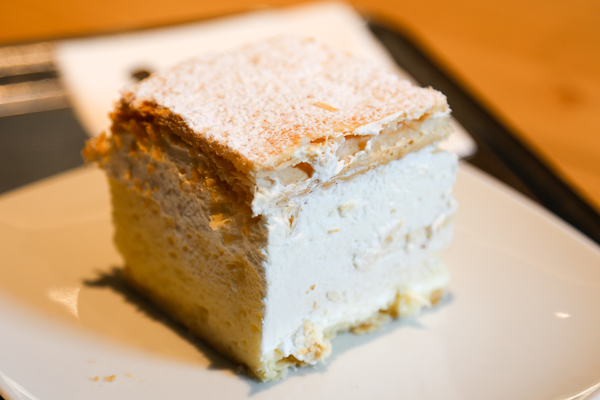
With nearly every shop and restaurant closed on Sunday, we fueled up with leftover bread from breakfast before sitting down at Kavarna Veronika (see map) for coffee and dessert. On a weekday we would have visited the town museum at Grad Zaprice and perhaps one of the new microbreweries that Kamnik has become famous for in recent years.

After the light meal we caught the next bus back to Ljubljana and spent our final afternoon at the few supermarkets open on Sunday, completing our last minute souvenir shopping prior to our evening flight. After traveling 1200 km through six countries in the Balkans, it was time to go home and pay for the bill.

In hindsight we could have held off booking our cottage at Velika Planina until the last minute in hope of picking a sunnier date, but we should be satisfied with memories of that magical hour as we strolled through this inimitable medieval village. Velika Planina is not quite Shirakawa-go yet -- as of 2019 it remains largely unknown to foreigners and, perhaps most amazingly, villagers outnumbered tourists on the day of our visit. Get here soon, before it gets discovered by 21st century mass tourism.
IF YOU GO
Velika Planina is easily accessed by a cable car nearly year round, but the best season for hikes is between June and September. The bottom station is 90 minutes from Ljubljana on direct buses operating in high season. Alternatively one could take one of the frequent buses to Kamnik's bus terminal and transfer to a local bus for Kamniska Bistrica. If scheduled buses don't work for you, our taxi from the cable car station back to Kamnik cost about 15 euros as of 2018. One more practical tip -- the Tourist Info office at Kamnik's town square was happy to stash my backpack for a few hours while we toured the historic town. Don't bank on leaving it overnight though.