Saturday, April 2, 2016

Renting a Trullo in Alberobello


I kept several must-dos in mind as we traveled for 23-day down the full length of Italy:

1. Hiking the Italian Dolomites
2. Staying in a cave house in Matera
3. Renting a Trullo in Alberobello


Two out of the three were in Italy's deep south, which helped alleviate the boredom on our longest day of travel, more than 10 hours of bus-train-bus from Urbino to Pesaro to Bari to Alberobello. But it was worthwhile -- as much as we appreciated the romance of Venice and San Marino, our trip would have been much less fulfilling without this final week in Puglia and Basilicata.


Half of our time in the south would be spent among these distinctive Pugliese farmhouses known as the Trulli, little whitewashed sugar cubes awkwardly fitted over with fanciful wizard hats for roofs. They’re as far as can be from the sophistication of a Fiorentine palazzo and other classic definitions of Italian architecture, but there’s just something magical to fall in love with.


I didn’t understand my love-at-first-sight with Alberobello until weeks later when I read of its uncanny connection as a sister town with my favorite destination in the world, the secluded Shirakawago and its signature Gassho-zukuri thatched roofs. Both towns feature ingenious architectural adaptations to historical hardships in the local environment -– heavy snow in mountainous Central Japan, and heavy taxes in feudal Southern Italy.


Prior to arrival I had arranged to rent one of these whimsical mushroom-shaped houses for a couple nights, without knowing the functional weakness of this ancient architectural form especially on humid days. But that’s just the authentic quirkiness -- much like enduring the lack of insulation when renting a traditional Japanese Machiya house -- that completed our full Pugliese experience.


Getting to Alberobello wasn’t as straightforward as we hoped, especially on Sundays when the FSE, Puglia’s regional private rail operator, replaced its reliable train service with an infrequent bus schedule that ran only 5 times a day. Even the locals weren’t fully familiar with this replacement service, as nobody at the bus stop could tell me whether it was the right bus for Alberobello.


So we waited with the locals at an unmarked street corner (known locally as Largo Sorrentino) just south of Bari Centrale station, killing a couple hours of time checking out the vending machines and the streetside bar-caffes before the bus finally arrived to carry us, as well as a sweaty team of teenage footballers after their weekly fixture, on our way towards Alberobello.


Make no mistake about it –- we’re now fully in Trulli country as our bus winded through the sparsely populated countryside of olive plantations, wild cactus pears, and anonymous whitewashed hamlets with their signature conical roofs.


Two hours later our driver dropped us off a block from Alberobello Stazione (note: it turned out necessary to tell the bus driver to stop at the TRAIN station, or we would have ended up at the Alberobello BUS terminal across town). The ambience was absolutely enchanting in the early evening as we strolled towards our rental trullo.


Our little trullo was situated at the heart of the upper town, 7 minutes walk from the train station and just a couple minutes from arguably the Alberobello’s best known attraction, a relatively lavish former residence known as Trullo Sovrano.


Just around the corner was the town’s Baroque basilica. It was exactly one week before the patron saint's feast day and the streets leading to the basilica were fully decked out in a festive atmosphere.


Across town stood a distinctive local specimen of a church, the Parrocchia Sant'Antonio, fashioned in the form of a ginormous trullo with half-metre-thick walls and turret-like stone roofs.


The real attraction in Alberobello was its labyrinth of meandering narrow alleys –- especially in the northern neighborhoods -- surrounded by endless whitewashed trulli on all sides where every street corner appeared vaguely identical except to the local inhabitants. Once in a while we would find ourselves going hopelessly in circles, and had to depend on our maps.me app to escape from the maze.


It was much harder to get lost in the southern neighborhoods where the wider streets were lined with rows upon rows of souvenir shops, and its alleys filled with busloads of mostly British and Japanese tourists stopping by for the obligatory day-trip. We bought some handmade leather goods from a local artisan, but as it turned out leather items would get even cheaper when we subsequently visited Lecce.


In retrospect it was ideal to stay in the northern part of town for its authentic atmosphere with relatively few tourists, and wander to the southern neighborhoods in the early evening as the day-trippers left and locals came out to socialize.


As mentioned we booked our trullo ahead of time, a few months in advance in fact, from a local operator named Trullivacation. Checking in was quick and easy as we dropped by the rental office at the dead-end street of Vico Gentile (1 minute walk west of the Basilica), and the friendly manager even carried our large backpack for us to our trullo located another minute’s walk away.


Our house was one among an entire block of rowhouses of trulli, all plastered with a uniform whitewashed facade that would appear quite ordinary from the outside, betrayed only by the little conical roofs peeking above the concealment.


The flat facade was only a 20th Century enhancement for ease of maintenance -- the interior was really in the form of a cylindrical space divided into the master bedroom on the main floor, a loft beneath the vaulted roof, and a seldom used basement level.


With two more beds in the loft our trullo could have slept four in probably 300 square feet of space. Modern amenities such as heating and air conditioning were of course provided, but the absolutely indispensable appliance in this unique rural architecture was the dehumidifier.


As it turns out all trulli are plagued with one serious design flaw: the heavy accumulation of moisture trapped under the impenetrable stone ceiling and exacerbated by the presence of shallow ground water in the basement. The manager mentioned about a future plan to install a jacuzzi in the basement, though in retrospect it would sound rather ambitious given the trullo’s predisposed weakness.


Located next to the front entrance was a tiny but functional kitchen with an induction stove top and hood fan, built-in refrigerator, and the Italian necessity of an espresso machine. Milk, juices, yogurt and other essential breakfast ingredients were all conveniently included for free. While the supermarket was only four minutes’ walk away, we never quite got used to Alberobello’s unusually long Riposo when even gas station convenience stores closed between 13:00 and 17:00.


We thoroughly enjoyed every moment of our stay in this cozy little trullo -- relaxing and functional, conveniently walkable to everything in town, and as uniquely Pugliese as we dreamed of. In fact we would have loved to stay for a whole week to properly explore nearby Martina Franca, Locorotonto and Grotte di Castellana.


RESTAURANT REVIEWS

We tried three restaurants in town: one was mediocre enough that I won’t waste my time to review, and the other two did turn out quite enjoyable.

TRATTORIA AMATULLI
Via Garibaldi, 13, Alberobello; 1 minute walk from the main square (Piazza del Popolo)


Hidden inside a nondescript 19th Century city block just east of Piazza del Popolo, Trattoria Amatulli wasn’t exactly easy to stumble upon without a good map. But the little eatery has made its name among visitors for years, serving up a ginormous multi-course dinner of nothing but traditional local recipes, complete with house wine and a digestivo (Limoncello!) for a flat rate of 25 euros per person.


How ginormous are we talking about? Pictured here was just HALF of the Antipasti for two -- the full Antipasti wouldn’t even fit on one plate -- consisting of Salsiccia Stagionata from nearby Martina Franca, Capocollo Pugliese from local producers, and a robustly flavored hard cheese known as Canestrato Pugliese.


My favorite Pugliese cheese was these succulent white sacks of fresh Burrata, a firm and chewy mozzarella-like cheese with its signature thick cream oozing out from the centre. And for those who prefer a softer and milder cheese, generous wedges of the creamy Cacioricotta was also served. You can imagine how we were getting full after the Antipasti alone, with three more courses still to come.


Thankfully the Primo, a dish of handmade Ravioli ai Porcini, was much more manageable in size. We probably should have picked the other choice of Primo (Orecchiette of some form), as the Porcini here turned out quite bland compared with the Porcini we had in Alto Adige and Le Marche.


My wife was entirely full even before the arrival of this Porchetta al Forno con Patate as a Secondo, and I barely had room for half of it. The only thing we successfully finished was the 1/2 litre of house red included with our meal.


Dessert was again classic Pugliese from the local interpretation of the familiar Cantucci to the regional favorite of Tarallini. I couldn’t resist the offer of a free Limoncello to wrap up this massive meal, and paid for the decadence by waking up the next morning with a headache. While none of the dishes were out-of-this-world delicious, it was a fascinating gastronomic adventure through all the local specialties in one sitting, in a 4-course meal including wine and digestivo. Did I mention that the 25 Euros per person also includes the Coperto?

Bill for Two Persons
Degustazione Menu25 Euros
TOTAL50 Euros (CAD$70)


While Trattoria Amatulli was undoubtedly interesting, my tastebuds actually much preferred our lunch spot the next day in a seemingly more touristy joint.

IL TRULLO D'ORO
Via Felice Cavallotti, 27, Alberobello; located on the side street, 2 minutes walk to the north of Piazza del Popolo.


This was exactly the type of restaurant I usually try to avoid: situated right next to the town’s main drag, housed in some traditional architecture -- a cluster of 19th Century Trulli in this case -- and posting an English translation of its menu outside. But I have a superior radar with me -- my wife’s keen sense of smell picked up something special from the kitchen’s exhaust fans.


And she was absolutely right. We started with a superb Zuppa di Cozze that became the envy of the entire dining room when this giant pot of piping hot Mediterranean mussels arrived at our table. While one can usually depend on great seafood in Puglia, Alberobello was about an hour from the coastline and we did come across a stale sea bass at a different restaurant later that day. These mussels though simply couldn’t have been any fresher, and we certainly couldn’t have asked for a bigger portion for just 10 euros.


Featured prominently on the Primi section of the menu was the Pugliese favorite of Orecchiette in various sauces and preparations. At this point I hadn’t yet discovered the magic of Orecchiette con Cime di Rapa, and here we picked one with stewed lamb in a tomato based sauce, and one in a green pesto with Pancetta.
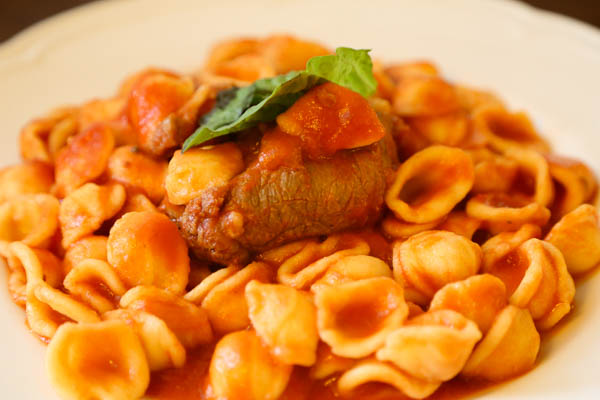


The Ragu Agnello was my favorite of the two Orecchietti, both priced reasonably at 9 euros despite the apparent popularity of the restaurant with tourists. That said, the best Orecchiette of our trip would come several days later outside of Puglia, at the town of Matera in Basilicata.

Bill for Two Persons
Zuppa di Cozze10 Euros
Orecchiette con Ragu Agnello9 Euros
Orecchiette con Pesto e Pancetta9 Euros
Bottle of Water2 Euros
Coperto x 23 Euros
TOTAL33 Euros (CAD$46.2)

Saturday, March 19, 2016

Urbino, the Best Kept Secret of Central Italy?


It was the perfect sunset over the Apennines, the last golden rays of a lazy afternoon reflecting off the Disney-esque twin turrets of the 15th Century palazzo at this remote small town.

Yet the town hasn't always been remote and small. At one point this held the most refined of Italy's princely courts, a powerful city-state that assembled some of the best literary and artistic masterminds at the height of the Renaissance. Five hundred years later we sat on a grassy slope overlooking one of the most visually striking palaces anywhere in Italy, though Urbino is now largely neglected as a little-known town in a faraway province.


We arrived at Urbino exactly one week after the famous Festa dell'Aquilone, the annual kiting festival and a modern vestige of ancient traditions at this geographically isolated locale, nestled on the Adriatic side of the Apennine Mountains away from the influence of cultural heavyweights such as Rome or Florence. Its remarkably steep alleys could be mistaken for those of any Tuscan hilltown, except for the lack of tourists compared with Siena or San Gimignano.


Despite being venerated as a UNESCO World Heritage Site for its immaculately preserved Renaissance townscape, Urbino is far from becoming a household name even among the Italians themselves. My Italian coworkers seemed puzzled by my itinerary to venture this far into unknown territory -- Puglia and Basilicata they applauded, but Urbino in Le Marche? Apparently most Italians haven't visited, let alone casual foreign tourists, which is exactly why we came.


Every visitor to Italy knows of Florence and its brilliant flourishing of everything Renaissance, yet few have heard of its obscure twin, an anti-Florence so to speak, situated on the opposite side of the Apennines. As the other cradle of Italian Renaissance, Urbino once contested with its better-financed brother for cultural supremacy, and in fact it was only recently discovered in an encoded letter that its Duke did try to assassinate the ruling Medici brothers of Florence. Fast forward a few centuries though, and Florence has grown into one of the world's premier tourist destinations while Urbino has slipped into anonymity at a distant and humble province.


Today's Urbino is much better known as a vibrant university town hosting one of Italy's oldest academic institutions, with classes held in many historic palazzi and an air of scholarly composure that permeates its centuries-old neighborhoods. Tourists are a precious few while its armies of university students and faculty, 13,000 strong and more populous than the local citizens, drive the town's economy with their grocery runs and aperitivo hours. For independent travelers who may appreciate some youthful exuberance in a magnificent little town off the beaten path, this is the place to be.


Getting here wasn't straightforward -- we happened to arrive by SCHOOL BUS from San Marino (read the long story here). As unconventional as it might seem, this daily commuting vehicle for middle school students provided by far the quickest connection between these two unmissible UNESCO World Heritage Sites. While we did have to flag down our bus at 06:45 in San Marino, it offered the advantage of arriving at Urbino by 08:00 for a full day of exploring the town's timeless Renaissance charm.


By 08:30 we had already dropped off our luggage at the 3-star Albergo Italia next door, perfect for starting our day at the town's most iconic landmark, the pink-bricked palace of Duke Federico da Montefeltro, an exceptional military leader and quintessential Renaissance Man who singlehandedly elevated Urbino to the cutting edge of culture in the 15th Century. From its stately courtyard to the grand spiral staircase, the trendsetting Palazzo Ducale has long served as the ultimate blueprint and object of plagiarism for Renaissance palaces elsewhere in Italy.


While art lovers typically visit the Palazzo for the Galleria Nazionale delle Marche and its world-renowned collection of Renaissance paintings from Barocci to Titian to Urbino's favorite son Raphael, I was much more drawn towards its airy architecture as well as its decorative details, the most amazing being these stunning inlaid wood panels inside the Duke's tiny studiolo.


Outside the Palazzo this lovely young couple emerged from their wedding inside the town's neoclassical cathedral to have their best moment captured on these front marble steps. This was the first of two Italian weddings we witnessed on our trip, the next one being in Lecce in the deep south.


To be honest the Italian weddings we came across were much more reserved than popularized in the English speaking world, the most boisterous segment being the much anticipated bouquet toss.


Visiting in the off-season comes with advantages and disadvantages: while tourists were almost non-existent, lesser-known but still spectacular sights such as the Oratorio di San Giuseppe would close its doors by 13:00. Our unintended early arrival turned out to be ideal for wrapping up our half-day of sightseeing just in time to enjoy the luxury of an afternoon nap.


Housed inside this unassuming oratory is one of Urbino's most distinctive sights, a 400-year-old life-sized nativity scene of stucco statues built into the walls of a natural grotto.


The neighboring Oratorio di San Giovanni Battista was the only place in Urbino where we encountered an organized tour group, a small legion of Italian speakers receiving a lecture on these captivating medieval frescoes. At this point the oratories started to close for the afternoon, and it was time for everyone to take up the local tradition of the midday riposo.


Later in the afternoon we took a walk around the town's expansive medieval walls, a formidable 15 metre wall of elegant pink sandstone and bricks and complete with a multitude of bastions for that perfect panorama of the surrounding Italian countryside.


By sheer luck we chanced upon the annual Gran Premio Nuvolari as dozens of classic cars rode through the historic squares of Urbino! One of these Fiat 508 Balilla ended up winning the 3-day race after 1,000 grueling kilometres across Central Italy.


Just before sunset we followed the local families and they hiked up the extraordinarily steep Via Raffaello to the highest section of the walled city, a green space known locally as Fortezza (formally Parco della Resistenza, as we later found out) overlooking the Palazzo Ducale for that famous postcard view of the Renaissance town in its 15th Century urban setting.


In a brief moment of brilliance the sunlight pierced through the distant clouds and landed on the Palazzo. The children gasped, the lovers kissed, and all the cellphones came out for the impromptu selfies. This lasted for about two minutes before the sun set behind the Apennines the families started to pack up: it was time for dinner.


RESTAURANT REVIEWS

TARTUFI ANTICHE BONTA
Via Raffaello Sanzio, 35, Urbino; one minute walk uphill from Piazza della Repubblica.


With a storefront advertising "Prodotti Tipici e Tartufi," Tartufi Antiche Bonta may appear as a typical Salumeria / gourmet shop to the uninitiated with its wide selection of truffle sauces and dried pasta. But next to its shelves of truffle oil a small staircase leads downstairs into a hidden cellar operating as an Enoteca, with just four precious tables. Needless to say, reservations are a must even in the low season.


That said, this is not a proper Ristorante or even Trattoria, but an Enoteca focusing on its selection of local vintage and serving up some regional Salumi and cheeses to go with the wine. At the bargain price of just 12 euros per head for the fixed menu we half expected to leave semi-hungry, but our worries were immediately negated by this sizable plate of Crostini, smothered in cheese and sprinkled with shaved local truffles.


The main course tonight was a gigantic cutting board of excellent regional cheeses and cured meats from Salame to Coppa to some succulent Prosciutto di Carpegna. On the side was a basket full of fresh Crescia, the distinctively fluffy, pastry-like flat bread that crumbles in the mouth akin to Indian Roti. It was clear then that we would not leave hungry -- in fact we never finished the bread.


Going perfectly with the Salame was a bottle of fruity Passerina (Umani Ronchi Vigor Passerina 2014) from the local hills, again at a very reasonable price of 9.5 euros.


The selection of cheeses ranged from the soft and delicate Ricotta to the prized Casciotta d’Urbino to some aged Caprino, complemented with dried figs, apricot jam and organic honey.


For Dolce our Biscotti Secchi were served with small glasses of Duke Federico's favorite wine, the syrupy sweet and fruity Vino di Visciole made from tiny cherries indigenous to Le Marche. Perhaps it was the mixing of two different alcohols on this evening, but I did wake up the next morning with a rare hangover.

Bill for Two Persons
Degustazione Menu x 224 Euros
Bottle of Umani Ronchi Vigor Passerina9.5 Euros
Coperto x 23 Euros
TOTAL36.5 Euros (CAD$51.1)


At less than 20 euros per person for a light dinner this is certainly my number one recommendation in town. Number two is a cheap breakfast joint.


CORNETTERIA PECCATI DI GOLA
Via Giuseppe Mazzini, 28, Urbino; located on the long and steep Via Mazzini, 1 minute from Piazza della Repubblica.


Pictured here were two of the best Cornetti of our entire Italy trip, fresh out of the oven and injected with the customer's choice of flavor only upon ordering to prevent the cream from sogging up the pastry. The result was the flakiest, most scrumptious Cornetti with the richest and nuttiest fillings of pistachio and vanilla. Regretfully I did not get a picture of the storefront, but it should be easy to find as everyone in town knows this place.

Bill for Two Persons
Cornetto with Chantilly Creme1.5 Euros
Cornetto with Pistachio Creme2.0 Euros
TOTAL3.5 Euros (CAD$4.9)


Finally we also tried one of Urbino's most popular Osterie, which was worth a mention even though it might not be as an amazing deal as Tartufi Antiche Bonta.


OSTERIA URBINO KM 0
Via Puccinotti, 21, Urbino; located directly across from the Duomo.


This was about the only time that we had an lunch all'aperto on an Italian town square, as we generally try to avoid such restaurants and their typically overpriced and mediocre food like the plague. But this place boasted a menu entirely derived from Urbino's local ingredients (hence "KM 0"), and we decided to give it a try.


And it wasn't bad, though my wife did find her dish of smoked goose breast slightly underwhelming as the flavor of the meat was completely masked by the strong Pecorino di Fossa and balsamic vinegar. I probably enjoyed the dish more than she did, but then I'm usually the one who appreciates bolder flavors.


I could not resist ordering -- without even knowing the price -- the daily special of Tagliatelle al Tartufo Fresco, the simplest possible dish of pasta with nothing but boiled Tagliatelle and shaved black truffles on top. To be honest the truffles were not quite as sharp and flavorful as I hoped for, and while the amount of shavings was quite generous, the mystery price of 15 euros was a little higher than what I wished to pay for a lackluster dish.

Bill for Two Persons
Petto d'Oca10 Euros
Tagliatelle al Tartufo15 Euros
Bottle of Beer4 Euros
Coperto x 22 Euros
TOTAL31 Euros (CAD$43.4)


The 3 euro gelato at Gelateria Raffaella (corner of Via Donato Bramante and Via Raffaello) turned out to be a much more enjoyable bite in comparison. We dropped by the little gelateria twice before hopping on the 07:35 bus the next morning to Pesaro, connecting with the high speed Frecciabianca on a 4.5 hour train ride to Italy's deep south.