Friday, December 8, 2017

Madrid - Cheap Traditional Eats from Breakfast to Dinner


From Castillian pig's ears to Galician razor clams to Andalusian red shrimps and more, Madrid's culinary scene is a chaotic yet effortless amalgamation of diverse culinary traditions from all corners of the Iberian Peninsula. With thousands of restaurants to choose from, we stuck with the most traditional, time-honoured eateries for classic Madrileño flavors.

BREAKFAST:

CHOCOLATERIA SAN GINES (Madrid)
Location Map

Whether you're waking up early from jetlag or stumbling after an all-nighter at the club, there's no better place to start a new day in Madrid than this legendary 24-hour churreria at the city centre. For more than 120 years, Chocolateria San Gines has served generations of Real Madrid players and local celebrities their routine of Porras and Cafe con Leche at this inconspicuous dead-end alley just west of Puerta del Sol.


Some airy Porras or the crunchier Churros? That's the perpetual question for every customer picking up this prototypical Spanish take-out breakfast. On this day we ordered two scrumptious Porras to go with the signature cup of thick, dark chocolate. An early morning dose of 19th century elegance hardly comes any cheaper, right?
Bill for Two Persons
Chocolate con 2 Porras4 Euros
TOTAL4 Euros (CAD$6)


It does get even cheaper actually. Just steps from Chocolateria San Gines stands another Madrileño favorite renowned for its delectable pastries since Year 1894, for less than 2 euros a piece.


PASTELERIA LA MALLORQUINA (Madrid)
Location Map

Situated smack-dab on Puerta del Sol, the indisputable heart of Madrid and Kilometre 0 of all Spanish roads, La Mallorquina transcends gastronomy into modern Spanish history and the collective memory of all Madrileños. Behind perpetual crowds buzzing along the glass counters is a little staircase to the second floor cafeteria that served as a political hotbed leading up to the Spanish Civil War ... and that was over 80 years ago. This place is a legend amongst Madrid's legendary eateries.


Don't be intimidated by the enormous crowds awaiting their spots at the ground-level cafeteria. Try to make eye contact with the staff behind the glass counter and -- here's the difficult part -- be quick and decisive with your takeout choices! A couple of pillowy Suizos perhaps? Or some crunchy Palmeras? Or maybe a classic Napolitana ... oh wait ... now I have to choose between three different flavors!


Our choice this morning was a crisp, buttery Napolitana filled to the edges with luscious custard cream, along with a mysterious, orange-sized orb known as Trufa Grande that many locals seemed to be ordering.


It turned out to be a chocolate lover's dream, a giant ball of dense chocolate mousse sprinkled with even more chocolate. I cannot emphasize enough the incredible silkiness of the mousse as it pressed against the tip of my tongue -- this instantly became my favorite dessert of this 16-day journey, at a cheap 1.9 euros.
Bill for Two Persons
Napolitana de Crema1.3 Euros
Trufa Grande1.9 Euros
TOTAL3.2 Euros (CAD$4.8)


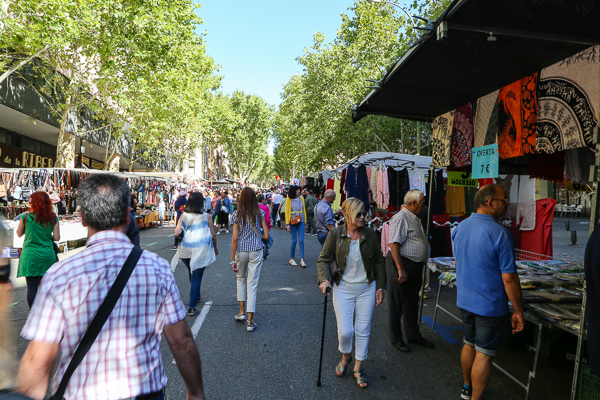
A great place to walk off that rich ball of chocolate mousse is El Rastro, a ginormous open air market sprawling over multiple city blocks from Ronda de Toledo all the way to La Latina metro station every Sunday morning. From quaint bullfighting posters personalized with your name to one-of-a-kind artisan wallets, the wide range of knickknacks provides enough amusement such that even non-shoppers like ourselves ended up spending about 80 euros.


LUNCH:

Coincidentally or not, the area immediately north of El Rastro happens to be home to many of Madrid's time-honoured restaurants and taperias, the oldest being the 300-year-old Sobrino de Botin. Here we began a unhurried afternoon of Tapeando, the local pastime of hopping from one gastropub to the next in search of one's favorite Tapas.

CASA REVUELTA (Madrid)
Location Map

This is another of Madrid's oldest eateries, dating from Year 1860 when the idea of a Spanish Republic was still a daydream. Locating Casa Revuelta is easy; you really can't miss its large crowd of faithfuls attempting to squeeze into the tiny taperia. At one point I considered giving up, but we persisted for about 10 minutes and eventually found a fortuitous opening to the counter.


"Dos cañas y dos pinchos de bacalao" was the magical phrase that I had to rehearse in my head -- there was no time to waste at the counter with two dozen people waiting for my spot. But ordering was relatively simple as the kitchen churned out just one legendary item: baskets upon baskets of deep-fried bacalao, a hundred kilograms a day in fact.


It was worth the wait -- the batter was magically crispy, and the bacalao was so succulent that I was almost licking the juices running down my forearm. The codfish was minimally seasoned with nothing but salt, but why would anyone need more seasoning when you've got fish this fresh?


We spent less than 10 minutes at the bar counter before giving up our spot for the next guy, but not before the essential routine of tossing the dirty servilleta on the floor like everyone else. You know this taperia is legit when you can hardly take a step without stepping on a serviette ... or a pincho skewer.

Bill for Two Persons
Pincho de Bacalao x 26 Euros
Caña x 22.4 Euros
TOTAL8.4 Euros (CAD$12.6)


Barely a hundred metres down the street, the same Tapeando crowd can be found buzzing around another popular eatery famous for a different sort of Tapa.


MESON DEL CHAMPIÑONES (Madrid)
Location Map

Compared with the centuries-old Sobrino de Botin and Casa Revuelta on the same block, Meson del Champiñones is a relative newcomer at 60-years-young. A small and somewhat inconspicuous storefront belies a literally cavernous interior where a disproportionately tourist-filled crowd -- thanks apparently to Japanese guidebooks -- packs the interior mainly for the one celebrated dish.


Rather than standing at the bar counter, we settled for a sit-down lunch of Tapas starting with one of my favorite Spanish dishes, the ubiquitous Pimientos de Padron with their smoky skin, flavorsome flesh and no seasoning other than rock salt. Seriously I have never come across a plate of Pimientos de Padron anywhere in Spain that I didn't like.


Our appetite was well-primed for the restaurant's namesake, the one stellar dish that graced every table and filled the whole vaulted room with the unmistakeable fragrance of fried garlic. A ridiculously simple combination of mushrooms, Jamon Iberico, garlic, olive oil, and dry sherry, Champiñones al Ajillo is one of those rustic dishes that truthfully reflects the quality -- in this case very favorably -- of the raw ingredients.
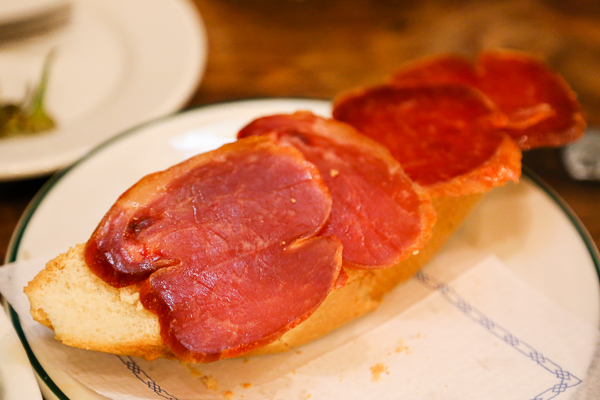


In fact we probably could have ordered one more plate of Champiñones instead of this Pincho de Lomo -- not that we didn't enjoy the dry-cured pork loin, but the garlic mushrooms were head and shoulders better than everything else. Given the slightly inflated prices I would recommend dropping by simply for a caña and some champiñones, and combine with Casa Revuelto for a light lunch.

Bill for Two Persons
Pimientos de Padron7.9 Euros
Champiñones al Ajillo7.3 Euros
Pincho de Lomo4.9 Euros
Botella de Cerveza x 26.4 Euros
Bread Charge x 22 Euros
TOTAL27.5 Euros (CAD$41.2)


Another 50 metres ahead and we've reached the famous Mercado San Miguel with dozens of gourmet taperia stands, pastelerias and fishmongers vying for most tourist business under its century-old iron frame. Its dubious reputation for Spain's most skilful pickpockets -- and inflated prices -- meant that it was probably wise to arrive on full stomach and enjoy the atmosphere on the sideline.


But I couldn't resist visiting the fishmonger upon the sight of a finished shell of fresh sea urchin on a table, only to learn that the day's catches were mostly sold out. A couple pieces of artisan Baklava were all that we purchased before heading back for a little siesta.


DINNER:

CASA TONI (Madrid)
Location Map

If I have to pick one tapas bar that best represents the authentic Madrid, this is it.

I've sat next to the window and watched dozens of English-speaking tourists horrified by the mystery meats at the storefront. Squeamish eaters should scroll down to the next restaurant review for some garlic shrimp, but if you're curious about what the Madrileños really enjoy, without any prejudice, then this hole-in-the-wall place is a MUST VISIT.


Skip the sight of uncooked entrails and pig ears if you must, but you cannot escape the 1960s decor while you get seated with your glass of Rioja, or perhaps Tinto de Verano, which would invariably come with a free tapa such as these pinchos of Jamon York with a dash of paprika. As rough-around-the-edges as this small gastrobar may appear, this is the real, unadulterated Madrid for its generations of faithfuls.


The menu is dominated by home style dishes like this generous plate of deep-fried eggplants with honey or stewed beef tripes with chorizo and chickpeas. The greasy smoke and aroma of seared pork fat was emanating from the hotplate behind the counter as we patiently waited for the shop's most popular creation ...


Orejas a la Plancha, or grilled pig ears, perfectly charred, crunchy as expected on the bite and served with thick, spicy Bravas sauce on the side. While we did have previous exposure to pig ears mainly from Sichuanese dishes, the richness of flavors and texture made these Orejas a surprisingly great match for a glass of Rioja. And at a cheap 5.5 euros (CAD$8.25), this excellent tapa might just be the best deal we came across in Madrid.


Finally, the famous ingredient that helps drive away the odd unsuspecting tourist from the display window and elevates Casa Toni as one of Madrid's most beloved eateries for Casqueria, or offal meats. It also happened to be our first ever encounter with the euphemistically named lamb sweetbread, i.e. the thymus gland of lamb.

Seared on the hotplate and sprinkled with a heavy dose of chopped herbs, this Mollejas a la Plancha really surprised us with a firm, meaty texture compared with its limp and mucus-laden appearance behind the display counter when raw. My tastebuds probably craved the Orejas even more, but there's a certain mystery to the Mollejas that added to the dish's Old World charm. At the end we paid 13 euros per person for dinner including a drink, certainly a bargain within 5 minutes' walk from Puerta del Sol.

Bill for Two Persons
Berenjenas6 Euros
Orejas a la Plancha5.5 Euros
Mollejas a la Plancha9.5 Euros
Glass of Sangria2.5 Euros
Glass of Rioja Crianza2.6 Euros
TOTAL26.1 Euros (CAD$39.2)


That little stretch of Calle de la Cruz soon became our go-to spot for dinner, not only because it was a 3 minute walk from our rental apartment, but mainly for the convergence of two of our favorite Tapas bars -- Casa Toni and Casa del Abuelo.


CASA DEL ABUELO (Madrid)
Location Map

Just 30 metres down the block from Casa Toni stands an even older establishment, famous also for its own Madrileño favorites. Featuring old school wooden counters and optically imperfect mirrors from its 110-year-old history, Casa del Abuelo should fit just about everyone's perfect image of a classic Tapas bar, serving a smallish range of offerings but most renowned for just one dish.


And while we awaited that one stellar dish, we started with some Tomates Aliñado, a popular summery dish of fresh tomatoes in a salty vinaigrette that had the opposite effect of quelling our hunger while the smell of fried garlic from the back kitchen became stronger and stronger. What came next would become one of our best memories of the trip ...


Gambas al Ajillo -- my favorite dish over our 16-day journey across Spain -- served sizzling in a fired earthen Cocido and flavored with little else but garlic, dried cayenne pepper, and perhaps a dash of Sherry by some accounts. The best part wasn't just the shrimp, but the incredibly aromatic oil that we couldn't help mopping it all up with bread!

In fact I was so impressed with this dish that I have since invested the time to learn to emulate it back in Canada. Yet I doubt that I would ever attain this level of heavenly savouriness at home, at least that extra saltiness in the shrimp flesh that clearly pronounced its Mediterranean origin. We ordered Gambas al Ajillo a couple more times in Spain, but this was just a notch above the rest.


Perhaps I should have purchased a few bottles of the housemade garlic-shrimp-infused oil -- available for about 10 euros -- and lugged them back to Canada. I still have to master the art of frying shrimp shells to extract that crustacean flavor for the oil, and can't wait to add this to my regular rotation of comfort dishes at home.

Bill for Two Persons
Tomates Aliñado6.5 Euros
Gambas al Ajillo10.9 Euros
Glass of Tinto de Verano2.6 Euros
Glass of Sangria2.6 Euros
Bread Charge x 21.2 Euros
TOTAL23.8 Euros (CAD$35.7)


The above six eateries are all 50-plus-year-old institutions located conveniently within a short walk from the absolute centre of Madrid, namely Puenta del Sol and Plaza Mayor. But one night we also ventured a little south to the vibrant, multi-ethnic neighbourhood of Lavapies for a small and completely packed Tapas bar recommended to us by a local.


LA BERENJENA (Madrid)
Location Map

If popularity with native residents is the ultimate sign of an authentic local eatery, this little gastrobar would surpass all expectations. In fact the lone waitress was so completely overwhelmed that one of the regular clients volunteered to greet these two clueless foreigners. The entire floor was absolutely jam packed to the point of everyone literally spilling drinks on one another, and the only available seats belonged to two tiny, make-shift tables on the way to the washroom at the back.


As uncomfortable as that might sound, it didn't stop the neighbours from swamping the tiny bar so badly that sitting down at a table came with the charge of an extra euro for each dish, a standard strategy to encourage turnover. But not everyone orders formal dishes as one could easily fill up on the free tapas such as this Ensalada Rusa that came with our cañas of beer.


I could not resist ordering our fourth dish of razor clams within our first week in Spain -- it was that addictive. But far from the prototypical Navajas a la Plancha with garlic oil and herbs, this house specialty came with a tropical cream sauce of coconut, cilantro and a squeeze of Sriracha for a kick. The complexity of the sauce might have been slightly distracting from the natural Umami of the razor clams, but it was still a delicious and refreshing combination.


Carrillera de Ternera, a veal cheek slow-braised in wine and topped with a cream of goat cheese and rosemary. While the portion could have been a little more generous, the flavors were very sophisticated for a dim, inconspicuous bar on a residential side street, almost within walking distance from Atocha train station. This place is popular for good reasons.


The best deal of the evening was this beautiful Semicrudo de Entraña, a barely-seared skirt steak in a Provencal sauce featuring a heavy dollop of parsley and generously seasoned with rock salt. At a cheap 9 euros (8 if you're standing at the bar counter) I seriously doubt that you can find a better steak for its price in central Madrid.

Bill for Two Persons
Navajas con Crema de Coco, Lima, Sriracha y Cilantro14 Euros
Carrillera de Ternera y Crema de Queso al Romero13.5 Euros
Semicrudo de Entraña y Hierbas Provenzales9 Euros
Caña x 46.8 Euros
TOTAL43.3 Euros (CAD$65)


So that's it for dinner. What next?

AFTER DINNER:

Craving the quintessential Spanish art form of flamenco but don't fancy paying the 30 to 50 euros charged by most tablaos in central Madrid? Hop on Metro Line 2 to Las Ventas bullring and walk over to the dark and cramped Cafetin la Quimera where clients sit at most 20 feet away from the intricate footwork (and thunderous taconeos!) in the most intimate setting. Price for the 1 hour 40 minute performance? Just 17 euros at the time of writing.

SLEEP:

As mentioned above, we rented an apartment within a short walk from most of the above tapas bars, and a 5 minute walk from Puerta del Sol, the undisputed centre of Madrid and a major transport hub for Metro and Cercanias trains ... all for a cheap price about 60% of the cost of our Barcelona apartment. There were two catches though -- there was no air conditioning, and the loft bedroom was accessible via a steep flight of stairs. Search up L&H Plaza Santa Ana if interested.

Monday, November 27, 2017

Medieval City of Toledo


Two medieval towns on opposite ends of the tourism scale, and we crammed both into our itinerary in a short 3 days.


After two nights at the charming provincial town of Cuenca where tourism still takes a backseat to agriculture, we moved straight to the middle of the beaten path at Toledo, an ancient city reborn as one of Spain's most popular destinations especially after the opening of the high speed rail spur from Madrid.


Boasting a medieval centre full of marvellous architectural gems from its 2000 year history, Toledo was once what Madrid is today -- capital of the Iberian Peninsula and royal seat of a kingdom stretching from the French border to North Africa. This was in fact the heart of the Spanish Empire at its height when a seemingly endless supply of gold and silver flowed in from the New World, contributing to a level of opulence still apparent at its cathedral.


From its Roman stone bridge across River Tagus to remnants of Moorish mosques to a renowned stronghold that held back fierce Republican gunfire during the Civil War, Toledo itself is a fascinating contraction of Spanish history. We would have preferred two nights, but that would have reduced Cuenca, Segovia or Salamanca to just one. Such is the universal dilemma facing all curious travelers.


We arrived at Toledo on the high speed AVE train via Madrid -- we would have taken the highway bus directly from Cuenca if the timetable were more favorable. Greeting all travelers from a distance was the classic image of an stalwart medieval fortress on a hilltop, blessed with the natural defense of a river gorge on three sides and a colossal wall on the fourth.


Our rental apartment was a short bus ride away next to the local bus hub of Zodocover Square, a 2-minute walk from the imposing Alcazar and right across the street from the cleverly camouflaged escalator that led towards the long distance bus station just outside of the town walls.


It was a bachelor suite in the form of a small rooftop cabin with its own private patio, complete with a small but functional kitchen and satellite TV, at a 40% discount compared with our Barcelona apartment. Not quite as cheap as Cuenca, but just about anything was cheaper than Barcelona as we're about to find out.


The best part of the apartment was of course the spacious rooftop patio, four storeys up above the town walls with sweeping views of the Tagus and the rolling Manchegan plains on the horizon. It took willpower to pull ourselves away from this view and start exploring the town.


Our first stop was the 600-year-old Sinagoga del Transito, built by the king's Jewish treasurer and served as a private family synagogue for over a century until it was converted into a church after the expulsion of Jews in 1492. Jewish inscriptions from Psalms entwine seamlessly with Mudejar flourishes and intricate Moorish stucco work that echoes the Alhambra.


More Mudejar panels grace the ceiling of Monasterio de San Juan de Los Reyes, an impressive Gothic church originally intended as a mausoleum for arguably the most renowned of Spanish monarchs, Ferdinand and Isabella who unified the Spanish crowns, completed the Reconquista of the Moorish south and sent Columbus to discover the New World.


The centerpiece of all is the Cathedral of Toledo, an 800-year-old Gothic masterpiece best known for the so-called El Transparente, a baroque altarpiece ingeniously illuminated by an unusual skylight cut into the cathedral's back wall. Gleams of sunlight would pass through another expertly carved hole in the altarpiece and strike the tabernacle, only once a day.


Facing the congregation is an older and arguably even more elaborate altarpiece, a 3-storey gold-gilded wood panel illustrating the life of Christ from nativity to crucifixion and ascension. Look no further in case you're wondering what this former Spanish capital did with its New World gold that Pizarro and contemporaries pillaged from the Incas.


The cathedral's bell tower offered a panorama of Toledo's medieval skyline, pleasant though slightly obstructed compared with the view from the smaller church of San Ildefonso in the next block to the west.


But the most iconic view of Toledo is actually from across River Tagus at an elevated view point known as Mirador del Valle, just below the posh state-owned Parador hotel. Here one can appreciate medieval Toledo's prowess as a majestic stronghold, shielded on three sides by a sharp bend of the river and accessible only via a three heavily fortified stone bridges.


Our original plan was to take a quick taxi to the Mirador then a 3km downhill hike to the 14th century arched bridge of Puente de San Martin. At the end we got lazy and hopped on the touristy train-bus for a 60 minute trip around the perimeters of the walled town, including this highlight stop at the Mirador.


Towards the end of the trip we passed by the 16th century town gate of Puerta de Bisagra, impressively crenellated and prominently bearing the imperial emblem of the Habsburgs, proud reminder of an era when the mightiest empire in the world was centered right here in Toledo.


In the evening we spent much time on our private patio, enjoying the panorama of the lower town while hundreds of local families passed underneath towards an end-of-summer fiesta and concert held just outside the Gothic cathedral. One hectic day at arguably Spain's best-preserved ancient cities was far too short as we suspected.

Enough of sightseeing. What about the food you ask?

Just last year Toledo was honoured as Spain's Capital of Gastronomy for its distinctive dishes with rustic roots. While the locals may assert -- and correctly so -- that the best eateries are all in the countryside away from the tourist action, that didn't stop us from conveniently sampling a few native dishes within the medieval walls.


LO NUESTRO (Toledo)
Location Map

For lunch we stopped at this tourist-focused restaurant (i.e. English menus that I try to avoid if possible) on an easy-to-miss alley in the Jewish quarter, steps from Sinagoga del Transito and a few minutes' walk from either Monasterio de San Juan de Los Reyes or from the Cathedral.


What drew us in were Menus del Dia promising a range of regional dishes such as the pictured oven-baked Migas with jamon and raisins, plus deer and partridge from the local hunters. Prices weren't exactly cheap -- nor would I expect such at a town full of day-tripping tourists -- but were somewhat reasonable at 17 euros for 2 courses with drinks.


Blessed with the lush foothills of Montes de Toledo, this region is nationally famous for its tradition of game meats ranging from wild boars to venison to partridges and hares. We shared two such dishes starting with this Ciervo en Salsa, or venison slow-braised in red wine and served in a clay cazuela. In fact this was my most memorable dish in Toledo, a true meat-lover's favorite with its rich, unabashedly gamey flavors and generous portions.


Much less flavorsome was the Perdiz con Pochas, another local favorite of stewed partridge with white beans served at just about every restaurant within the old town. Honestly I could not even tell the difference in terms of flavor between this partridge and a generic chicken. After one remarkable dish and two lackluster ones, I'm not sure that I would recommend this restaurant.

Bill for Two Persons
Menu del Dia17 Euros
Judias con Perdiz10 Euros
Cerveza Artesana3 Euros
Vino Castilla la Mancha4 Euros
TOTAL34 Euros (CAD$51)


That final dish must have been disappointing enough that I wanted to give Toledo's partridges one more chance to redeem themselves on my tastebuds. That led us to our next restaurant.

RESTAURANTE FABULA (Toledo)
Location Map

This was the authentic local eatery that we had been searching for: small and cozy, a wholly Spanish clientele that typically preferred to stand at the bar than to sit, and a single waitress who spoke only Spanish. Needless to say we were the only non-Spanish clients that evening.


And the menu feature none of the celebrated Toledano classics like Ciervo en Salsa or Perdiz a la Toledana, opting instead for the same ingredients in refreshed interpretations catering to the local townsfolk. Remember the flavorless stewed partridge from lunch? Here our partridge was deboned, pulled and tossed into fresh salad, and the gamey essence of the wild partridge was day-and-night compared with the earlier dish. This was the Toledano partridge that I had been salivating for.


We also ordered an appy of sauteed mushrooms and this well-executed dish of seared duck breast with rock salt and vinegar reduction. Not exactly a standard Toledo dish, but a pleasure at less than 10 euros.


Surprisingly the partridge salad turned out to be the most expensive dish in a moderately cheap dinner with an appy, two mains and a dessert -- an airy orange soufflé pictured above -- to share, plus wine and beer, for about 19 euros per person. This was much better value in retrospect compared with our choice for lunch, and finally a restaurant in Toledo that we thoroughly enjoyed.

Bill for Two Persons
Ensalada de Perdiz13.5 Euros
Champinon a la Plancha5 Euros
Magret de Pato9.5 Euros
Souffle de Naranja con Chocolate4.5 Euros
Glass of Red Wine2.2 Euros
Cana of Beer2.5 Euros
TOTAL37.2 Euros (CAD$55.8)


Venison and partridge aside, Toledo is arguably even better known for its Mazapan, a local recipe for the glazed almond-sugar confection that boasts its own Denominacion de Origen. We picked up 6 pieces -- the lavish pine-nut-covered variety being our favorite -- from the 160-year-old Pasteleria Santo Tome for snack and as part of our breakfast the next morning.

Bill for Two Persons
Pasta de Pinon x 22.38 Euros
Mazapan de Delicia x 21.79 Euros
Pasta de Almendra x 21.03 Euros
TOTAL5.2 Euros (CAD$7.8)


The nutty aroma of the Mazapan went surprisingly well with a platter of certified, hand-cut Jamon Bellota Iberico from Salamanca that we picked up in a vacuum pack from the local supermarket. Ingredients for this decadent breakfast probably totaled more than 12 euros, unprecedentedly expensive for our Spanish trip but certainly worth every cent.

Friday, November 10, 2017

Cuenca - Restaurants and Rental Apartment


Aside from spectacular views and ease of access, unheralded Cuenca also offered some of the best values in dining and apartment rental among the 13 Spanish cities we visited. Here are just some of the reasons why my wife ranks Cuenca among her favorites towns in Spain.


RECREO PERAL (Cuenca)
Location Map

Highly recommended by our apartment's owner, this classy riverside restaurant turned out as one of our favorites anywhere in Spain. We're talking about a gargantuan feast that our waitress predicted that we wouldn't finish, a 6-course modern Spanish menu with foie gras, oxtail and all, including a bottle of local red, for less than 30 Euros per head.


A 10-minute downhill walk from Cuenca's medieval quarters, Recreo Peral is widely considered the best upmarket dining option around Cuenca's old town. While it is possible to order a la carte, the best offer here is a Menu Ejecutivo which includes not just one or two, but four appetizers to share, plus individual entrees and desserts for each diner, plus wine. And sizeable appetizers too, apart from this first course of crusty Croquetas with a soft creamy filling of Jamon Iberico.


Appetizer #2 turned out to be my favorite dish in Cuenca -- a basketful of baby squids or Chopitos, tenderly deep-fried in Andalusian style and served with flavorful Padron peppers, substantial enough as a main dish anywhere else but relegated to one of four appetizers here. It was by far the best calamari-type dish I've had in recent memory.


Appetizer #3 was my wife's favorite and would be a highlight in just about any meal: two thick, generous slices of Foie Gras -- not Terrine de Foie Gras, but sizeable slabs of whole, velvety duck liver, deveined and expertly coated with a thin crust of delicious salt flakes. How this became buried among one of four appetizers in a 27.5 Euros set menu is still a complete mystery to me. An appetizer of Foie Gras of this size and quality currently costs about 15 euros in Madrid.


Appetizer #4 was a local style of Migas involving some humble bread crumbs, moistened, generously seasoned with paprika, sprinkled with hand-torn specks of Jamon Iberico and raisins, oven-baked and topped with a soft egg. I probably tasted only a few spoonfuls, not because it wasn't good but because we're starting to get full even before the main dishes.


But first, a glass of iced granita as a palate cleanser, and a much-appreciated interlude between the four appetizers and the main courses.


And then the mains arrived. Luckily I did have the foresight to order a Steak Tartar instead of a Paella or a large chop of Iberico pork shoulder, which would have been unmanageably heavy as a fifth dish. Somehow I did muster the appetite to finish the entire steak, though a little more kick ... some briny capers perhaps? ... would have helped digestion.


While I didn't order a substantial dish, my wife did.

It was an excellent dish of Arroz Meloso con Cola de Toro y Setas -- Creamy Rice with Oxtail and Wild Mushrooms -- with superb meaty flavors all infused into the softened rice. We definitely tried our best, but were ultimately foiled by the physical limit to the size of our stomachs.


How we managed to find room for dessert I have no idea. But this Milhoja de Hojaldre, analogous to the French Mille-feuille featuring an luscious cream filling between scrumptious sheets of pastry, was so light and airy that my wife, a diehard fan of Mille-feuille/Napoleon, had no problem finishing.


At last, a molten lava cake in a tin can to cap an outstanding meal with impossibly generous portions. In retrospect I found the appetizers -- especially the Chopitos and the Foie Gras -- to be most enjoyable of all, but everything else from entrees to desserts and wine were top quality, especially at this attractive price.

Bill for Two Persons
Menu Ejecutivo x 255 Euros
TOTAL55 Euros (CAD$82.5)


That price-to-quality ratio was exactly why we always seek restaurant recommendations from the locals, who introduced us to another restaurant famous for regional cuisine, but at a cheaper price range.


SAN JUAN PLAZA MAYOR (Cuenca)
Location Map

With haphazard clusters of tables stretching down Plaza Mayor in the shadow of the gothic Cathedral, San Juan occupies by far the most desirable location anywhere in Cuenca. Based on our observation it's also the most popular restaurant in town, and not all because of its prime setting.


The appeal here is simple and effective -- regional recipes, ginormous portions of four appetizers plus entree, throw in some local wine and dessert for an unbeatable price of 15 Euros per person. Appetizers #1 and #2 were a tuna salad followed by Croquetas with a harder-than-usual crust and a filling that turned out denser than those at Recreo Peral.


Appetizer #3 was a classic Cuencan dish known Morteruelo, a rich, rough pate made from pork liver and mystery game meats such as wild hare, partridge, or whatever the hunters bring back.


Appetizer #4 was another local favorite known as Ajoarriero, a cold paté of salted bacalao, garlic and potatoes drizzled with herbed olive oil. We finished neither the Ajoarriero nor the Morteruelo as our colossal mains would soon arrive in the form of ...


... a whole leg of lamb from the casserole, slow-braised in its own juice and served bone-in for a simple yet richly flavored dish that I somehow found the appetite to strip down to the bones.


But the best dish of the evening was my wife's choice of Secreto Iberico, a highly sought-after cut between the shoulder blades of the black Iberian pig better known for lavish 150-euros-per-kg cured hams. It was an amazing pork steak, juicy and flavorsome to the degree of tasting closer to beef than to pork. In retrospect I don't understand why we didn't order Secretos more often while in Spain -- good luck finding this in Canada.


For desserts we shared a berry tart and a Spanish version of crème caramel known locally as flan. This was a tremendous amount of food -- not spectacular food but certainly enjoyable especially for travelers curious about rustic regional recipes -- for just 15 euros per person.

Bill for Two Persons
Menu del Dia x 230 Euros
TOTAL30 Euros (CAD$45)


All these heavy meals called for a comfy bed for those long siesta naps. As tempting as the majestic Parador, housed in a medieval monastery built at the edge of a sheer cliff, appeared despite the 180-euros-a-night price tag, we came across a better deal for a self-service apartment without giving up that canyon view, for about a quarter of the price.


How much of a good deal? How about a bachelor suite with a gorgeous view down Cuenca's famous canyon, cozy decor, excellent new appliances including satellite TV, stove, fridge, coffee machine and even a washing machine for those weeks-long trips, including K-cup coffee and simple pastries for breakfast, a two-minute stroll from the medieval square and cathedral, for less than 50 Euros at the time of writing? That's cheaper than half-price compared with our dirty spartan apartment in Barcelona.


For two mornings we woke up to this panorama of fellow cliff-side houses overhanging the Huecar Canyon, stretching beyond the town onto the arid plateaus of La Mancha. Did I mention that Felix the owner was so gracious that he woke up at 06:30 just to get us a taxi to the train station? Look up Apartamentos San Martin in Cuenca -- you'll thank me for it.