Friday, November 3, 2017

Living on the Edge in Cuenca


Between Valencia and Toledo we spent two nights at a historic hill town that most non-Spaniards have never heard of.


Like most foreigners, we knew embarrassingly little about Cuenca prior to arriving on a high speed train, halfway between Valencia and Madrid on the AVE route. We knew nothing of the town's attractions, its lip-smacking cuisine, or that we're about to crash an end-of-summer fiesta at its medieval town square.


Most first time visitors to Spain would probably visit the Iberian heavyweights of Madrid and Barcelona, and for train travelers there are two obvious AVE routes: a shorter route via Zaragosa, and a scenic route through Valencia and Cuenca. We chose the latter based on the merit of two UNESCO World Heritage Sites -- Valencia's Silk Exchange and Cuenca's Historic Walled Town -- and booked two nights in Cuenca.


Not to be confused with the metropolis in Ecuador that assumed its name, Cuenca, Spain is a small ancient town perched upon a rocky outcrop, surrounded by precipitous canyons carved out by the confluence of two rivers. Google the name and you'll likely see its cluster of Casas Colgadas, or Hanging Houses, featuring balconies cantilevered into the sidewalls and bravely overlooking the precarious drop below.


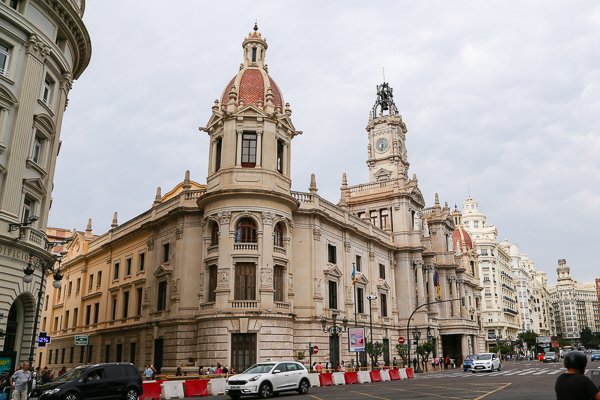
Our first sight of the medieval townscape came as the bus driver expertly squeaked our bus through the narrow arch of the baroque town hall, terminating at the aptly named Plaza Mayor with cobblestone paths randomly stretching in all directions. Felix, the owner of our rental apartment, was already waiting for us.


Built on top of an ancient Moorish citadel, Cuenca is your classic Castillian hill town centered on a cozy town square crowned with a 13th century cathedral, still shielded by defensive walls dating back at least a thousand years when the Arabs named it Kunka.


Our apartment was located right at the cliff edge overlooking the deep, vertical gorges, merely 40m from the famous Casas Colgadas and a two-minute walk from Plaza Mayor and the cathedral. The old town is long and narrow with just one main street that stretches 700m from the 16th century watchtower of Mangana in the south to the ruins of the Moorish castle in the north.


Impressive for a town of its size is the imposing cathedral, in fact the first ever gothic cathedral in Spain dating back to late 12th century, about the same age as the similarly styled (and infinitely more famous) Notre Dame of Paris. Curiously born with a notably Anglo-Norman facade, it would almost seem more fitting in Belgium or Northern France than here in Central Spain.


The interior decor was decidedly less gothic in comparison owing to various facelifts through the centuries, from renaissance arches to baroque altarpieces. And if you're wondering what might be meeting Jesus's upward gaze ...


... it's the dazzling painted cupola above. The cathedral grounds is also endowed with a bishop's palace now serving as a display for its collection of relics and priceless art, including a couple of El Grecos.


Behind the cathedral is the unmistakable symbol of Cuenca, its 600-year-old timber-framed houses overhanging the vertical face of the canyon. While only three such specimens remain today, in centuries past they would have been part of an entire row of hanging houses on the cliff edge, probably rivaling the Hanging Monastery of China in terms of visual impact.


Beneath the Hanging Houses spans the Puente de San Pablo, a former medieval stone bridge rebuilt as a turn-of-20th-century iron structure soaring over River Huecar, linking the town with the old Convent of St. Paul that has since reincarnated as a classy state-owned hotel.


The 500-year-old Dominican convent was just a dilapidated shell until about 25 years ago when the government transformed it into one of its most stunning Paradors. No need to pay 150 Euros for a room just to take pictures -- just walk in for a coffee for a reasonable 4 Euros.


The convent's baroque church has also been reborn into an exhibition space featuring modern art installations from Madrid's Reina Sofia Museum, one of the top art museums in the world best known for its collection of Picasso and Dali.


The gorges formed the old boundaries of Cuenca until the second half of 20th century when the urban sprawl stretched to the flatland. Over two days we never had the incentive to venture outside the town as an old-fashioned fiesta, evident from the white linen draped all over town, was about to kick off.


Today's festivities turned out to be a medieval-themed, end-of-summer fiesta put together by the local government, bridging the void between the full week of Feria de San Julian in late August and the upcoming Fiesta de San Mateo in late September. While the action was thrilling enough for this foreigner, it must have been quite minor among Cuenca's countless annual ferias and fiestas.


It's a medieval-themed party after all, and the fiesta promptly kicked off with a procession of royalties accompanied by banner carriers and a small but energetic medieval band that kept on pumping out festival music until midnight.


To stir up more drama a couple of Warcraft-like minotaurs and wizards showed up on tall stilts to rough up the adults and high-five the small children.


While the fictional characters paraded through town, an open-air market sprouted up on Plaza Mayor and its side alleys peddling everything from handmade accessories to cheap clothing to some excellent deals on leather goods. We loaded up on all sorts of souvenir items and a leather handbag right here.


As for snacks, artisan pastries and sweets, local Machego cheese and Jamon Iberico. We even came across a makeshift stand pouring some delicious honey mead. Mead! Now that's a medieval fiesta!


As the sun began to set, a Segovian pig roast was getting seriously underway alongside some Andalusian paella and roasted salchichas. It was a little worrying to see all corners of Spain being incorporated into one eatery, but my wife already had her eyes set on the Cochinillo.


Our plate of Cochinillo arrived in the form of bony pig jaws and cheeks ... and none of the meaty legs or bellies. I hope it was just our luck of the draw and not because we're non locals, but it felt like a rip-off at 25 euros ... and that's before we learned the price of our Sangria: 9 Euros for a large cup! Now that's the biggest rip-off we encountered over 16 days in Spain.

Bill for Two Persons
Cochinillo25 Euros
Sangria9 Euros
Bread Charge2 Euros
TOTAL36 Euros (CAD$54)


After dinner we walked down to Puente de San Pablo again for a view of the illuminated bridge with the Parador in the background. The prospect of stumbling over the iron girder bridge in dark seemed a little too hazardous though, and we turned back after the Casas Colgadas.


One of the best night views actually came from our apartment's window which offered an unobstructed panorama, past the town walls down the Huecar canyon. Spectacular views such as this only makes Cuenca's obscurity even more baffling, especially now that it's less than an hour from Madrid via AVE trains and has become perfectly doable as a day-trip. But on second thought, why not stay for a romantic night and enjoy the serenity ... or perhaps the raucous party if you happen to come across a fiesta?

Friday, October 27, 2017

Valencia in 3 Hours? Paella, Silk Exchange and Orxata


We wanted 2 days in Valencia in ideal, were constrained to 6 hours in planning, and ended up with 3 hours in reality.

But compromises are a part of traveling that we've learned to take in stride. Part of it -- losing 90 minutes to boarding the wrong train -- was my stupid mistake, and the rest -- losing another hour to a bloodied assault on the conductor that involved the dramatic chase and arrest of two fare-evading passengers in front of our train window -- was an uncontrollable freak incident.


With 6 hours we could have started with a leisurely lunch of Paella Valenciana, visited the famous Silk Exchange, admired the baroque interior of Parroquia Sant Nicolau and the 13th century Cathedral while sipping an ice-cold Orxata, and perhaps wrapped up with a taxi ride to see the stunning contemporary architecture at the City of Arts and Sciences.


A gorgeous metropolis with everything from charming historic neighbourhoods to grand 19th century boulevards to sleek futuristic event venues, Valencia probably deserves a week to properly appreciate and savour. But with only 3 hours in town before our high speed train connection to Cuenca, we had to condense our checklist down to three emblematic, unquestionably Valencian experiences.


First and foremost, an authentic Paella Valenciana at the birthplace of paella. Chunks of rabbit, chicken, liver, green and white beans adorned this ginormous pan of rice that turned out impossible for two people to finish. The only complaint was that half of our soccarat, the caramelized crust considered by many to be the best part of the paella, was charred to a black, inedible form.

TABERNA ALKAZAR (Valencia)
Location Map
Bill for Two Persons
Salpicon de Marisco13 Euros
Paella Valenciana26 Euros
Bottle of Water3.85 Euros
TOTAL42.85 Euros (CAD$64.3)


Made-to-order paella meals are never quick, and with less than 90 minutes remaining we headed straight for the Silk Exchange, the city's celebrated UNESCO World Heritage Site and a reminder of Valencia's 15th century heyday as a major power in the western Mediterranean.


On this day a group of local students came to study this proud chapter in the history of Valencia when it rose to mercantile prominence under the Crown of Aragon and as Castille's main port. Traders from as far as Northern Europe and the Near East congregated here to buy and sell textiles, and the Contract Hall served a similar function to today's Euronext or Chicago Merc.


Across from the Silk Exchange the baroque facade of Sants Joan del Mercat, a National Historic Monument in its own right, was a slight consolation for missing Sant Nicolau and the Cathedral. With about 40 minutes remaining it was time to stroll back to the train station to pick up our luggage from the locker.


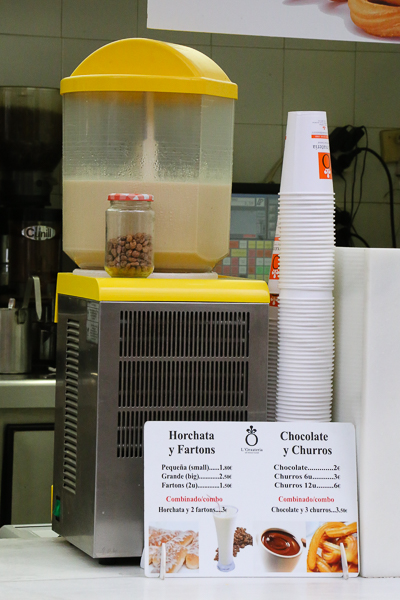
But not before stopping for an authentic Orxata from a street stand, on a humid 30 degrees day at the end of the Valencian summer! This smooth, nutty concoction became such a favorite for me that we always stopped whenever we saw signs for Horchata Valenciana, even as we traveled halfway across Spain.


We made it back to Estacio del Nord, one of the most beautiful train stations in Spain hailing from the age of Art Nouveau, with little time to spare considering that we still had to make it to the high speed rail station (Joaquin Sorolla) down the street! By 18:10 we were on the move again, zipping through the Spanish countryside en route to Cuenca, which would become one of my wife's favorite towns in Spain.

Monday, October 16, 2017

Barcelona - Review of 7 Eateries


Two important things I learned at Barcelona even before the secession referendum:
1. Catalans do not identify themselves as Spanish
2. Catalan cuisine is not traditionally known for tapas. That’s a Spanish import remember?

Catalan cuisine is more about rustic recipes served often in 3-course meals as I’ve since learned, somewhat reminiscent of Provencal cooking (Allioli vs. Aioli) and arguably closer to Marseilles than Madrid. Of the seven eateries we visited in Barcelona over three days, two were bonafide Catalan institutions and absolutely recommendable, and three others were somewhat recommendable for their price-to-quality ratio. We’ll start with the most memorable meals.

RESTAURANT L'HAVANA (Barcelona)
Location Map

This was unfortunately our last dinner in Barcelona; otherwise we could have dined here every night.

Tucked away in a multi-ethnic neighborhood west of La Rambla, l’Havana was recommended to me by a local as a 70-year-old Barcelonan fixture, serving standard Catalan dishes like Bacalla a la Llauna or even the simple Pa amb Tomaquet to its regulars. We showed up early at 20:00 only to find the lights dimmed, and waited outside until about 20:15. Needless to say, no other tourist was in sight for the entire evening.


One of their specialties was rumoured to be Carxofes Arrebossada, or deep-fried artichokes.

But my wife hates artichokes, grilled, fried, or pickled. I could order this appetizer for a cheap 5 Euros, but potentially get stuck with having to finish it all by myself.

Long story short, my wife finished half of it.

Tiny baby artichokes, simply halfed, battered and deep-fried. No need for any strong or complex flavors when you’ve got raw ingredients of this quality.


And that was followed by one of the best dishes of our trip, Navalles a la Planxa, or razor clams from the hotplate.

Being seafood addicts we had razor clams 5 times over 16 days in Spain -- 3 times in Barcelona alone -- and this was the absolute best. No visible usage of herbs except for garlic infused into the cooking oil; only live razor clams in their absolute freshness, grilled perfectly and seasoned with nothing but rock salt.


Then we arrived at standard Catalan dishes like Bacalla a la Llauna -- arguably the most celebrated Catalan dish of all -- a tenderly baked piece of cod loin, supposedly in a tin (a la Llauna) with a generous dose of paprika and more garlic.


Even better was this unassuming dish of Calamars Farcits, plump, fresh squids stuffed with octopus chunks and filled to the brim with ground sausage. The magic of this dish was in its sauce -- a messy-looking broth that belied its pungent, deep Umami flavor extracted from hours and hours of stewing parts of the octopus that didn’t make it into the stuffing. But the result was eye-opening -- this actually turned out to be my wife’s favorite dish.


We wrapped up with a luscious Crema Catalana, the local variant of Creme Brulee with a hard caramelized crust and a comparatively thicker custard derived from cornstarch. I cannot name one dish that we didn’t enjoy in a superb dinner of Catalan classics within a 10 minute walk from La Rambla. I can’t recommend this place enough, especially to curious travelers looking for that authentic, unmistakably Barcelonan taste.

Bill for Two Persons
Carxofes Arrebossada5 Euros
Navalles a la Planxa12 Euros
Bacalla a la Llauna14 Euros
Calamars Farcits10.5 Euros
Crema Catalana4.2 Euros
Glass of Cava3.25 Euros
Glass of Wine2.5 Euros
Large Bottle of Water2.95 Euros
TOTAL54.4 Euros (CAD$81.6)


If 27 Euros per person is beyond your backpacking budget, fear not -- we were also introduced to a blue collar joint serving full 3-course meals including wine for just 12 Euros.

CAL BOTER (Barcelona)
Location Map

A traditional eatery set among corner stores and auto repair shops in the laid-back urban village of Gracia, Cal Boter is well-hidden from tourist crowds and yet conveniently located a couple metro stops away from Sagrada Familia.

In fact this little gem made the perfect lunch spot between our visits to the World Heritage monuments of Sagrada Famila and Hospital de Sant Pau. No other non-Catalan speaker was in sight ... nor was there an English menu, but one of the staff members went out of her way to translate for us.


What could 12 Euros possibly buy in one of Europe’s most expensive cities? An appetizer of grilled Escalivada or in our case a rich spinach soup, an entree from a list of Catalan favorites such as the pictured Botifarra amb Mongetes, a dessert, and a half litre of house wine or a beer. Anything cheaper and you'll probably end up at 100 Montaditos.


But it’s worthwhile to pay extra for one of the house specialties, ranging from Peus de Porc amb Cargols (Pig Trotters with Snails) to the pictured Bacalla Grata Colloni, one of our favorite dishes in Barcelona featuring a moist, flaky piece of baked cod smothered under the richest, foamiest Allioli.


The Tarta de Santiago was unmemorable, but the wine was ... for the wrong reason. Having to scoop out little fruit flies -- one dead and one still moving -- from my wine wasn’t even the surprising part; the real shock was how the regulars seemed to be quite used to this routine! I guess we couldn’t have asked for a more authentic experience of lunching in an old-school neighborhood joint.

In retrospect, perhaps a beer would have been a better choice than the house wine -- at least it would have come in a sealed can!

Bill for Two Persons
Menu del Dia12 Euros
Bacalla Grata Colloni12.9 Euros
Bottle of Water2 Euros
TOTAL26.9 Euros (CAD$40.4)


Aside from the two time-honoured Catalan restaurants reviewed above, we also visited one sporting a modern take on traditional dishes.

BAR DEL PLA (Barcelona)
Location Map

This gastropub is at least 60 years removed from the likes of old school l’Havana while still serving what could be called Catalan cuisine, but in its own unique interpretation. I’m not sure if Wasabi vinaigrette will become the norm in 21st century Catalan fusion, but Bar del Pla is certainly leading the charge as we speak.


But first, some crisp, airy Croquetas of calamari in squid ink to start. While Croquetas and derivatives can be commonly found all over the Iberian Peninsula, it was in Barcelona where we most often came across these breaded morsels with the unmistakable black filling made from savory squid ink.


For less than 7 Euros this tapa of Crispy Oxtail with Foie was one of my favorite bites in Barcelona. Underneath the fried onion bits was a boneless chunk of slow-braised oxtail sporting its intense beefy flavor. In fact the oxtail was so perfect by itself that I thought the seared foie on top almost became a detraction.


Also memorable was the regional favorite of Peus de Porc, or boneless Pig Trotters stuffed with ... even more melt-in-your-mouth foie! With its gelatinous mouthfeel paired with crunchy peanuts and red paprika, the tenderly braised trotters took on an almost Sichuanese appearance.


Calcots in Romesco sauce would have been the default favorite in springtime, but this was late summer and we settled for some grilled lettuce. Good food overall, and decent price-to-quality ratio for a modern interpretation of Catalan fare, in trendy El Born just steps from Picasso Museum.

Bill for Two Persons
Croquetas Calamar x 23.6 Euros
Cruixent de Cua de Bou & Foie6.4 Euros
Peus de Porc8.1 Euros
Cogollos Romesco6.5 Euros
Beer x 25 Euros
TOTAL29.6 Euros (CAD$44.4)


If you just want a safe and reasonably priced choice for tapas without an absolute emphasis on Catalan cuisine, this popular Cerveceria worked out quite well for us.

CIUDAD CONDAL (Barcelona)
Location Map

Ciudad Condal needs no introduction as one of the most popular cervecerias/taperias in Barcelona, among both locals and tourists alike. Everyone starts with some Montaditos from the counter, in our case the regional speciality of Escalivada con Anchoas and a classic Jamon Iberico. Not quite dirt cheap as 100 Montaditos, but still a good deal at less than 2 Euros each.


As regional cuisine is always our focus, we couldn't resist ordering the house Canelones, the Catalan version of Canelloni baked in a béchamel-like sauce and traditionally served during Christmas. Very rich flavors and modestly priced at just 5.3 Euros.


We also ordered a plate of razor clams that, although not quite as good as that magical dish we had at l’Havana, was surprisingly fresh for a tapas bar. Better yet, what turned out to be our most expensive dish of the evening cost us less than 10 Euros.


To wrap up, a plate of Setas a la Plancha -- that’s chanterelles, shiitakes and oyster mushrooms, not just champignons -- for only 6.3 Euros. After a couple beers our tapas dinner totaled at about 15 Euros per person, a definite bargain considering we’re about a 2 minute walk from Placa de Catalunya and the centre of Barcelona.

Bill for Two Persons
Montadito de Escalivada con Anchoas1.8 Euros
Montadito de Jamon Iberico2 Euros
Canelones de la Casa5.3 Euros
Navajas a la Plancha9.25 Euros
Surtido de Setas6.3 Euros
Beer x 26 Euros
TOTAL30.65 Euros (CAD$46)


But if you’re looking for something conveniently off La Rambla, is open even on Sundays, and does not take August off when half the city’s restauranteurs seem to be on summer vacation, you’ll probably end up here like we did:

LA FONDA (Barcelona)
Location Map
This was actually our first meal in town on a Sunday, jetlagged off the plane and searching for some authentic Fideua as an introduction to Barcelona. Los Caracoles down the block was still closed for summer vacation, and we settled for the always-open La Fonda.

La Fonda isn’t known for Catalan cuisine per se, and most of the clientele seemed to be non-Catalan/Spanish speaking tourists popping by for Paella -- well-appreciated by the locals but more of a Valencian dish than a Catalan one -- which is not the best sign. But prices were very reasonable for a classy-looking establishment steps from La Rambla, starting with its monthly special of Tapa Solidaria which turned out to be a pintxo of grilled octopus in a bed of pureed potatoes, for just 1 Euro.


But we did get our share of Catalan flavors in this Fideua de Mariscos con Allioli, a pan full of dried noodles simmered in a rich seafood stock and topped with langostinos, shrimps and mussels. To be honest I was quite pleasantly surprised by the Umami flavor of the broth, especially for its cheap price of 10 Euros. This was much better than the tourist trap that I feared!


We also chose a rice dish from the seasonal menu, an Arroz Marino which came with a deep-fried soft-shelled crab and some form of edible seaweed. The flavor wasn’t quite as good as the Fideua, though the crispy soft-shelled crab did provide a memorable moment.

While the food wasn’t top quality to be honest, for its combination of refined ambiance, decent flavors and very competitive pricing, I though La Fonda was a cheap and safe bet especially around La Rambla on a Sunday when many restaurants are closed.

Bill for Two Persons
Tapa Solidaria1 Euro
Fideua de Mariscos con Allioli9.95 Euros
Arroz Marino11.5 Euros
Beer1.95 Euros
Bottle of Water1.9 Euros
TOTAL26.3 Euros (CAD$39.5)


After five recommendable eateries, we’ve finally arrived at one that I would not recommend.

BODEGA LA PENINSULAR (Barcelona)
Location Map

Frankly this wasn’t our first choice at Barceloneta. Or perhaps the whole idea of having seafood at the harbour district was a bad one in the first place. But Cova Fumada was closed for vacation, as was Can Sole. Even La Bombeta was closed for some reason. Attempting to avoid the rows of English menus on Passeig Joan de Borbo, we ended up at Bodega La Peninsular.


The evening actually started quite well with these Croquetas of Calamari in Squid Ink, crunchy on the crust and flavorsome inside. This was the best dish before the rest of the meal started going downhill.


Next came the razor clams which, despite being excessively salty, were at least fresh and enjoyable as long as we brushed away the excessive seasoning. But nothing prepared us for the next couple of dishes.


This Sepia a la Plancha was among the most stale and flavorless cuttlefish we had ever tasted. I could forgive a seafood restaurant for using frozen stuff, if they at least make a decent effort with a little more charring on the hotplate, or perhaps a good rock salt for flavoring, or perhaps drizzling a quality olive oil for the finish. Unfortunately neither the quality of ingredient nor the effort was observed here.

At this point there were also two musicians who walked in playing their traditional ballads and actively pestered the clientele for money. Annoying, but not quite as inexcusable as the final dish.


This piece of Ventresca, or tuna belly, won the dubious distinction as the worst dish of our 16-day trip.

While this wasn’t my first time to be surprised with a whole mouthful of uncleaned fish scales in a restaurant, it typically happens with a whole steamed or baked fish with skin intact. But a mouthful of scales from a fillet of tuna belly, from a seafood specialty restaurant? On top of the fact that the doneness of the fillet as well as the seasoning were uneven, the scales really put the exclamation mark on a meal that went wrong in a multitude of ways.

Bill for Two Persons
Croquetas Calamares en su Tinta x 23.9 Euros
Sepia a la Plancha9.95 Euros
Navajas a la Plancha12.95 Euros
Ventresca a la Plancha16.95 Euros
Cava x 27 Euros
TOTAL50.5 Euros (CAD$75.8)


That’s enough of lunches and dinners. For breakfast we generally relied on supermarket supplies of Jamon Iberico and bread for our own homemade bocadillos, though we did come across a recommendable place for fresh handmade Churros. Not very Catalan I know, but addictive nonetheless.

CHURRERIA LAIETANA (Barcelona)
Location Map

For more than a half century, this tiny mom-and-pop Churreria has been an institution on Via Laietana, literally around the corner from Barcelona’s world-famous concert hall and walkable from either Urquinaona or Jaume I metro stations. As our apartment happened to be a 3-minute walk away, this became a convenient take-out joint for us.


This was where I first learned the phrase “chocolate con churros para llevar!” For 3.6 Euros this was one of life’s little pleasures, light, crunchy and a perfect marriage with the sweet chocolate dip. I don’t even need the extra spray of sugar, but I’ll leave the debate to the connoisseurs.

Bill for Two Persons
Xocolata amb Xurros3.6 Euros
TOTAL3.6 Euros (CAD$5.4)